0–200 m
Epipelagic zone
The sunlit zone: enough sunlight penetrates to allow photosynthesis. This is where the vast majority of known marine species live.
- 🌊Arctic Ocean
- 🌊Atlantic Ocean
- 🌊Indian Ocean
- 🌊Pacific Ocean
- 🌊Southern Ocean
- 🌊Caribbean Sea
- 🌊East China Sea
- 🌊Mediterranean Sea
- 🌊Red Sea
- 🪸Coral reef
- 🪸High seas / open water
- 🪸Kelp forest / seaweed meadow
- 🪸Mangroves
- 🪸Sea Ice

Narwhal
Monodon monoceros
Narwhal
Nicknamed "the unicorn of the sea", this Arctic whale carries a long spiralled tusk that long fuelled the unicorn myth in Europe.
🌊 0–800 m
- ⚡ Its spiralled tusk, actually a tooth, can exceed 2.5 metres in length
- ⚡ Dives up to 800 m on a single breath to hunt, one of the deepest dives known in a marine mammal

Japanese spider crab
Macrocheira kaempferi
Japanese spider crab
With legs that can span nearly four meters, this deep-sea Japanese crab holds the record for the largest living arthropod on Earth.
🌊 50–600 m
- ⚡ The largest leg-span of any arthropod on Earth, nearly 4 meters
- ⚡ An exceptional lifespan that may reach a century — rare among crustaceans

Clownfish
Amphiprion ocellaris
Clownfish
Immune to the venom of the anemone that hosts it, it spends its entire life in one spot, and can literally change sex if the group's female disappears.
🌊 1–15 m
- ⚡ Immune to the anemone's stinging tentacles thanks to a protective mucus
- ⚡ Sequential hermaphroditism: born male, can become the dominant female

Giant manta ray
Mobula birostris
Giant manta ray
The largest ray in the world, a peaceful filter feeder with a brain proportionally among the largest of all fish, able to recognise itself in a mirror in the laboratory.
🌊 0–1000 m
- ⚡ One of the few fish to pass a mirror self-recognition test in the laboratory
- ⚡ A brain proportionally among the largest of all fish

Common torpedo
Torpedo torpedo
Common torpedo
A living 'battery' ray that immobilizes its prey in a fraction of a second with a discharge of up to 200 volts.
🌊 2–70 m
- ⚡ Generates its own electric shocks, up to 200 volts, to stun prey and deter predators
- ⚡ Detects hidden, even buried, prey through electroreception

Frilled shark
Chlamydoselachus anguineus
Frilled shark
Nicknamed the "snake shark" or a living fossil, it has changed very little in 80 million years and resembles a giant eel with 300 needle-like teeth.
🌊 50–1500 m
- ⚡ Considered a living fossil, virtually unchanged for 80 million years
- ⚡ The longest known gestation period of any vertebrate: about 3.5 years
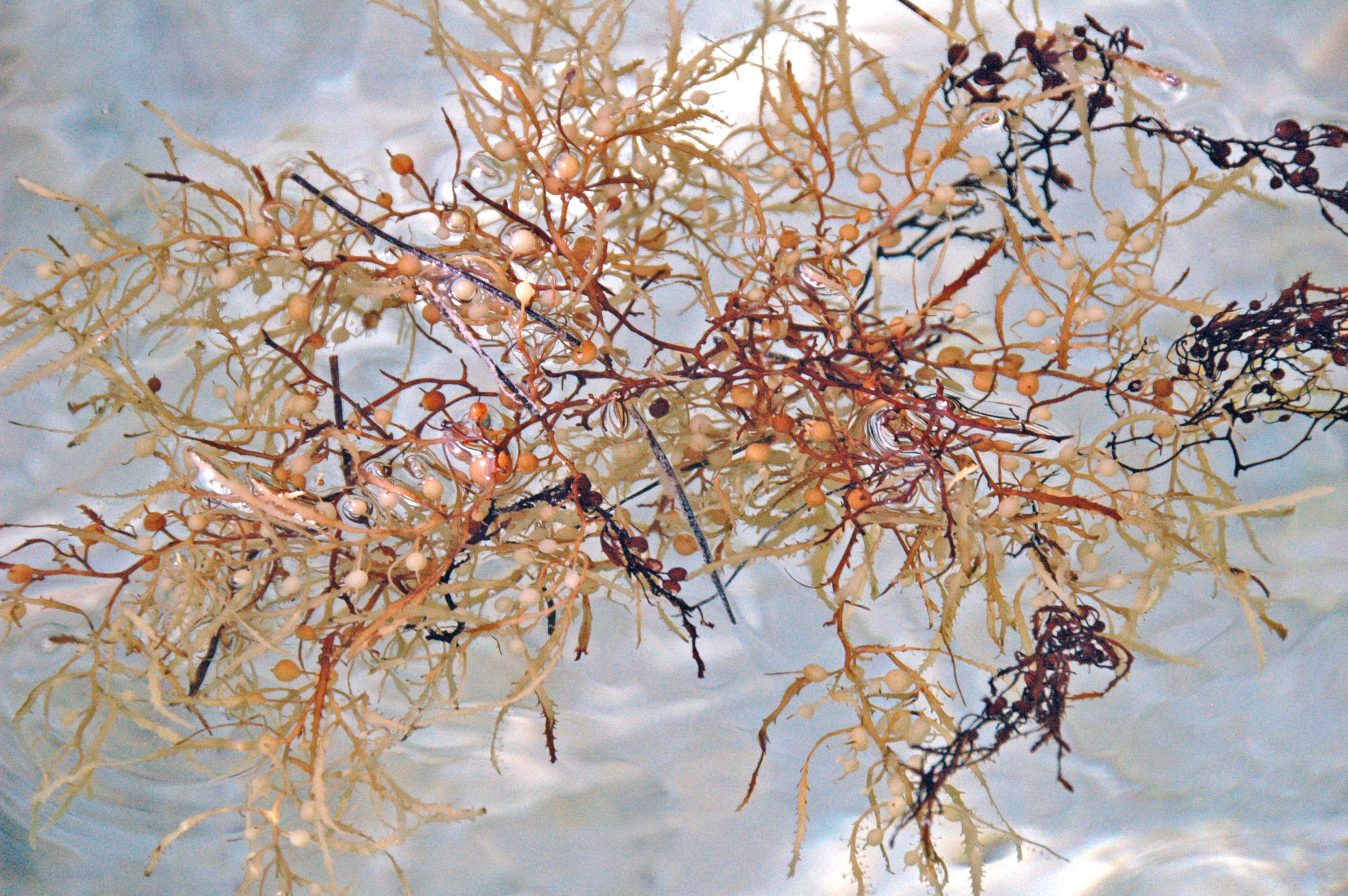
Sargassum
Sargassum natans
Sargassum
This brown alga never puts down roots: it drifts at the ocean's surface its entire life, forming immense floating rafts that gave the Sargasso Sea its name.
🌊 0–5 m
- ⚡ Reproduces only through fragmentation, with no sexual reproduction ever observed
- ⚡ Gave its name to an entire sea, the Sargasso Sea, which has no coastline at all

Megamouth shark
Megachasma pelagios
Megamouth shark
So rare it was only discovered in 1976, with fewer than 100 individuals observed since, despite reaching over 5 metres in length.
🌊 12–250 m
- ⚡ A species discovered only in 1976, one of the major zoological discoveries of the 20th century
- ⚡ A mouth that can open over a metre wide to filter plankton

Bargibant's pygmy seahorse
Hippocampus bargibanti
Bargibant's pygmy seahorse
No bigger than a fingernail, this tiny seahorse lives exclusively on a single species of soft coral, whose colour and bumps it mimics perfectly.
🌊 10–40 m
- ⚡ Camouflage so perfect it was discovered by accident, in a lab, on coral already collected for study
- ⚡ The male carries and hatches the eggs, one of the rare parental-role reversals in the animal kingdom

Sawfish
Pristis pristis
Sawfish
A sacred figure of the Dreamtime in several Aboriginal cultures of northern Australia, where its saw-shaped rostrum is said to have carved the course of certain rivers, it is today one of the most endangered fish families in the world.
🌊 0–40 m
- ⚡ Its rostrum acts as both a slashing weapon and an ultra-sensitive electrical radar
- ⚡ Can tolerate both salt and fresh water, sometimes travelling very far up rivers

Giant moray
Gymnothorax javanicus
Giant moray
Often perceived as menacing because of its half-open mouth, it simply breathes that way — and hides a second, retractable jaw worthy of a science-fiction film.
🌊 0–50 m
- ⚡ Has a second, retractable jaw that shoots into its throat to seize prey
- ⚡ Sometimes hunts as a team with groupers, a rare inter-species cooperation among fish

Mediterranean seagrass
Posidonia oceanica
Mediterranean seagrass
Some Posidonia meadows form a single clonal organism over 100,000 years old, potentially making it one of the oldest living things on the planet.
🌊 1–35 m
- ⚡ A single clonal individual may be over 100,000 years old, one of the oldest known living things
- ⚡ Captures up to 15 times more CO2 per hectare than an equivalent area of Amazon rainforest

Humpback whale
Megaptera novaeangliae
Humpback whale
Famous for its spectacular breaches out of the water and its complex songs that can last for hours, it undertakes one of the longest migrations known in any mammal every year.
🌊 0–200 m
- ⚡ Songs that can last for hours and spread from one population to another
- ⚡ Hunts in groups using a coordinated bubble net, a rare technique among whales

Blue-ringed octopus
Hapalochlaena lunulata
Blue-ringed octopus
Tiny and unassuming, it is one of the most venomous animals in the sea: its fluorescent blue rings are a warning to be taken very seriously.
🌊 0–20 m
- ⚡ Venom (tetrodotoxin) among the most powerful in the animal kingdom, with no known antidote
- ⚡ Bioluminescent-style rings that can flash in a fraction of a second

Sperm whale
Physeter macrocephalus
Sperm whale
The unwitting hero of the novel Moby-Dick and centuries of sailors' legends of titanic battles against monsters of the deep, the sperm whale does indeed fight real duels with the giant squid, whose sucker scars it often carries on its skin.
🌊 0–2000 m
- ⚡ Often carries sucker scars on its skin left by battles with giant squid
- ⚡ Among the deepest divers of all marine mammals, beyond 2,000 m, on a single breath for over an hour

Hermit crab
Coenobita sp.
Hermit crab
Unable to build its own shell, it spends its life squatting in abandoned ones, trading up for a bigger one as it grows — sometimes in genuine collective exchange chains.
🌊 0–10 m
- ⚡ Can organise a shell-exchange chain among several individuals of different sizes
- ⚡ Some species live almost entirely on land while still depending on the ocean to reproduce

Sea otter
Enhydra lutris
Sea otter
With not an ounce of blubber to shield it from the cold, it survives in the icy Pacific thanks to the densest fur in the animal kingdom — and cracks open shellfish with rocks like a tiny artisan.
🌊 0–30 m
- ⚡ The densest fur of any animal on Earth, its only defense against the cold with no body fat
- ⚡ One of the few non-primate mammals known to use tools (rocks) to open its prey

Giant carpet anemone
Heteractis magnifica
Giant carpet anemone
Host to many clownfish that are immune to its own sting, it can live for decades in the same spot without ever moving.
🌊 0–20 m
- ⚡ Can live for decades in the same spot without ever moving
- ⚡ Maintains a symbiosis with the clownfish, which in turn protects it from certain predators

Coelacanth
Latimeria chalumnae
Coelacanth
Believed extinct for 65 million years, alongside the dinosaurs, until its spectacular rediscovery in 1938 off South Africa.
🌊 150–700 m
- ⚡ Believed extinct for 65 million years until its rediscovery in 1938
- ⚡ Fleshy fins that move like limbs, close to the ancestor of the first land vertebrates

Lionfish
Pterois volitans
Lionfish
As spectacular as it is fearsome, its long venomous fan-like fins conceal a species that has become one of the greatest invasive threats to Caribbean reefs.
🌊 0–50 m
- ⚡ Venomous fins fanned out to intimidate and defend itself
- ⚡ A voracious appetite that fuelled a record invasion of the Atlantic and the Caribbean

Blue whale
Balaenoptera musculus
Blue whale
The largest animal ever to have existed on Earth, the blue whale makes the ocean tremble with the sound of its own heartbeat, audible from over two miles away.
🌊 0–200 m
- ⚡ The largest animal ever recorded on Earth — heavier than any known dinosaur
- ⚡ Its heartbeat can be detected from over 3 km away underwater

Sea cucumber
Holothuria sp.
Sea cucumber
A true vacuum cleaner of the seafloor, continuously recycling sand and sediment — some species defend themselves by expelling their own internal organs at an attacker.
🌊 0–1000 m
- ⚡ Can expel its own internal organs to repel a predator, then regenerate them entirely
- ⚡ Recycles a considerable amount of marine sediment every year, an essential ecological role

Great white shark
Carcharodon carcharias
Great white shark
An iconic apex predator able to leap clean out of the water to surprise prey, and to cover thousands of kilometres on transoceanic migrations still poorly understood.
🌊 0–1200 m
- ⚡ Can leap entirely out of the water to surprise prey at the surface
- ⚡ Ultra-fine electroreception via hundreds of ampullae of Lorenzini

Humboldt squid
Dosidicus gigas
Humboldt squid
Nicknamed the "red devil" for its shifting colour and aggression during group hunts, it can hunt in shoals of several hundred and communicates by rapidly changing colour.
🌊 0–1200 m
- ⚡ Changes colour in a fraction of a second, probably to coordinate group hunting
- ⚡ Tolerates extremely oxygen-poor zones inaccessible to most of its predators

Walrus
Odobenus rosmarus
Walrus
Recognisable by its long tusks, used to haul itself out of the water and assert its social rank, it locates prey buried in the sediment using extremely fine sensory whiskers.
🌊 0–80 m
- ⚡ Locates buried prey using hundreds of sensory whiskers
- ⚡ Uses its tusks like ice axes to haul itself out of the water onto the pack ice

Orca
Orcinus orca
Orca
The largest dolphin in the world and such a sophisticated apex predator that some populations develop hunting techniques passed down culturally from generation to generation.
🌊 0–500 m
- ⚡ Develops hunting techniques unique to each population, passed down culturally
- ⚡ A distinct vocal repertoire per family group, a form of dialect

Leopard seal
Hydrurga leptonyx
Leopard seal
Antarctica's top predator after the orca, recognisable by its reptilian head and immense jaw, able to hunt both penguins and other seals.
🌊 0–300 m
- ⚡ Can both filter krill and hunt large prey such as a penguin or a young seal
- ⚡ One of the few seals known to actively prey on other seals

Leafy seadragon
Phycodurus eques
Leafy seadragon
A fish that looks exactly like a drifting piece of seaweed — the most spectacular camouflage in temperate marine wildlife.
🌊 3–50 m
- ⚡ Near-perfect camouflage mimicking the surrounding seaweed
- ⚡ The male carries and protects the eggs until they hatch

Tropical two-wing flyingfish
Exocoetus volitans
Tropical two-wing flyingfish
A fish that escapes predators by launching clear out of the water and gliding on its giant, wing-like pectoral fins.
🌊 0–20 m
- ⚡ Launches out of the water and glides over the surface for tens of meters, aided by ultra-rapid tail-beats to relaunch its flight
- ⚡ Thanks to its two pectoral 'wings,' evades tuna and dolphinfish below as well as seabirds above

Sunflower sea star
Pycnopodia helianthoides
Sunflower sea star
One of the largest starfish in the world, able to move surprisingly fast thanks to more than 15,000 tube feet, but today decimated by over 90% by a mysterious disease.
🌊 0–120 m
- ⚡ Can have up to 24 arms and more than 15,000 tube feet
- ⚡ One of the fastest starfish known, over a metre per minute

Whale shark
Rhincodon typus
Whale shark
The largest fish in the world, a peaceful filter feeder that can reach the size of a school bus while feeding almost exclusively on plankton.
🌊 0–1900 m
- ⚡ The largest fish in the world, able to exceed 18 metres in length
- ⚡ A spot pattern unique to each individual, like a fingerprint

Crown-of-thorns starfish
Acanthaster planci
Crown-of-thorns starfish
Able to devour an entire coral reef within months during massive outbreaks, it is also one of the few starfish with genuinely venomous spines.
🌊 0–30 m
- ⚡ Can regenerate a whole individual from a fragment of its body
- ⚡ Can devour an entire coral reef within months during a massive outbreak

Giant kelp
Macrocystis pyrifera
Giant kelp
Perhaps the fastest-growing organism on Earth, giant kelp can gain over 60 centimeters a day and build an entire underwater forest within months.
🌊 0–30 m
- ⚡ Can grow more than 60 cm per day, one of the fastest growth rates in the living world
- ⚡ Forms underwater forests that host biodiversity comparable to a coral reef

Caribbean manatee
Trichechus manatus
Caribbean manatee
Nicknamed the "sea cow", its peaceful demeanour and habit of grazing on seagrass may have inspired mermaid tales among sailors of old.
🌊 0–10 m
- ⚡ Can eat up to 50 kg of aquatic vegetation a day
- ⚡ Its peaceful habits may have inspired mermaid tales among sailors

Goblin shark
Mitsukurina owstoni
Goblin shark
Nicknamed the "alien shark", it projects its jaws out of its head at blinding speed to catch prey — one of the strangest attacks in the animal kingdom.
🌊 100–1300 m
- ⚡ Can project its jaws out of its head in a fraction of a second to catch prey
- ⚡ Detects prey via electrical sensors spread across its long snout
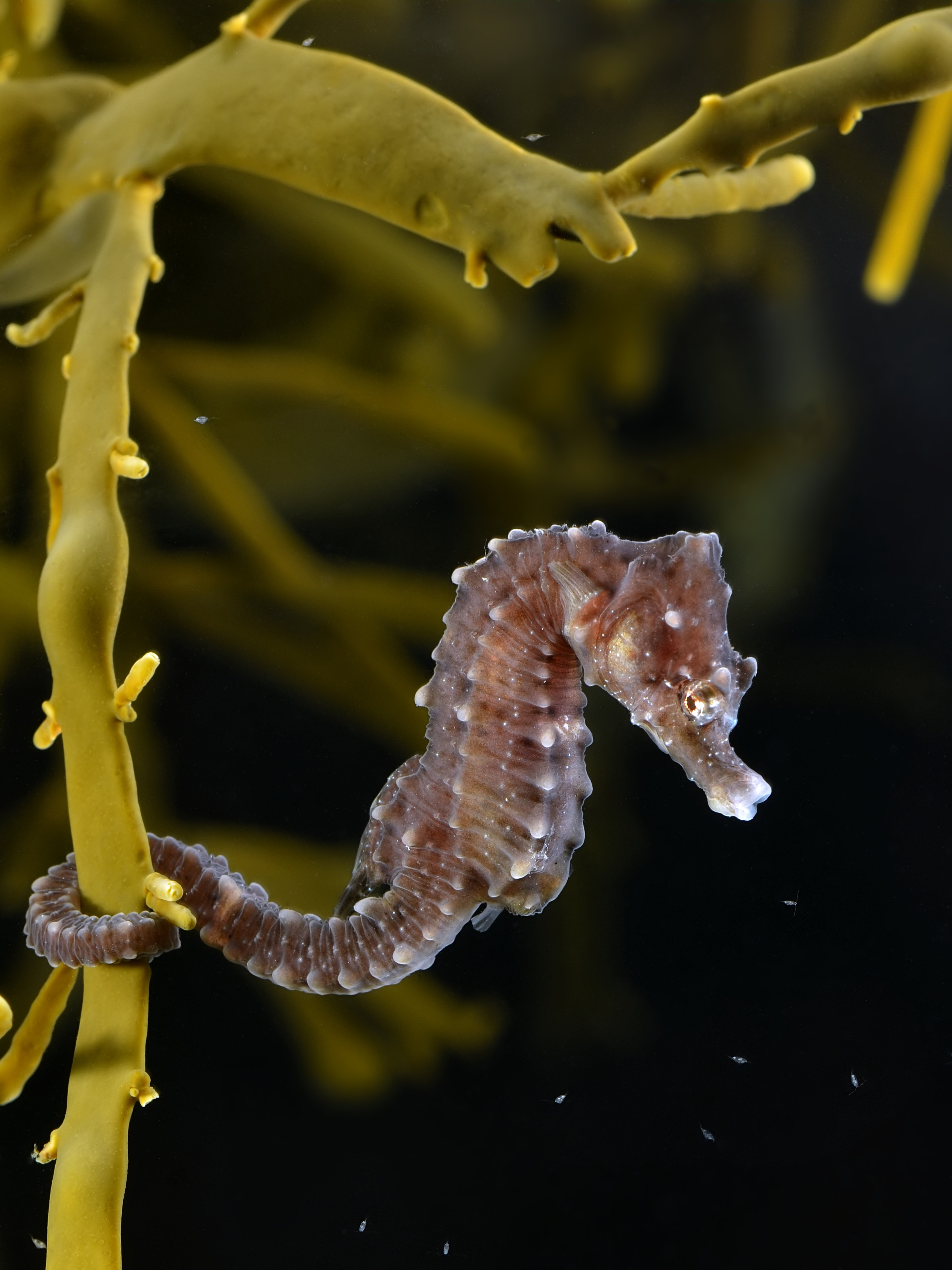
Short-snouted seahorse
Hippocampus hippocampus
Short-snouted seahorse
A tiny knight of the seagrass meadows, it is the male — not the female — who carries the eggs and gives birth, in one of the most striking role-reversals in the animal kingdom.
🌊 0–20 m
- ⚡ The male, not the female, becomes 'pregnant' and gives birth
- ⚡ Each eye moves independently of the other, letting it watch two directions at once

Atlantic bluefin tuna
Thunnus thynnus
Atlantic bluefin tuna
One of the fastest fish in the ocean, able to keep its muscles warmer than the surrounding water to cross the Atlantic during its migrations.
🌊 0–250 m
- ⚡ Can keep its muscle temperature above that of the surrounding water (regional endothermy)
- ⚡ Top speed among the highest of all bony fish

Giant triton
Charonia tritonis
Giant triton
Named after Triton, the sea's messenger god in Greek mythology who blew a conch shell to calm or unleash the waves, this huge sea snail is also one of the few natural predators able to keep crown-of-thorns starfish outbreaks in check on coral reefs.
🌊 0–30 m
- ⚡ One of the only natural predators able to keep devastating crown-of-thorns starfish outbreaks in check
- ⚡ Its shell has served for millennia as a ceremonial wind instrument in many Pacific cultures

Box jellyfish
Chironex fleckeri
Box jellyfish
Considered one of the most venomous creatures in the sea, its tentacles carry a venom able to trigger cardiac arrest in humans within minutes.
🌊 0–20 m
- ⚡ Has up to 24 eyes, some able to form a true image
- ⚡ One of the fastest, most potent venoms in the animal kingdom

Chambered nautilus
Nautilus pompilius
Chambered nautilus
A true living fossil whose shape has barely changed in over 500 million years, it navigates using a chambered shell that works like a natural submarine.
🌊 0–700 m
- ⚡ A shape virtually unchanged for over 500 million years
- ⚡ Regulates its depth like a submarine, using a shell with gas-filled chambers

Common brittle star
Ophiothrix fragilis
Common brittle star
Forms living carpets of thousands of fragile, spine-covered brittle stars that filter plankton from the current after nightfall.
🌊 0–200 m
- ⚡ Can voluntarily sever one of its own arms to escape a predator, then fully regrow it
- ⚡ Aggregates into ultra-dense living carpets, up to 2,000 individuals per square meter, forming a synchronized filter-feeding 'reef'

Polar bear
Ursus maritimus
Polar bear
Revered and feared as Nanuq in Inuit mythology, where it is sometimes described as an almost-human spiritual ancestor for its intelligence, it is also classified as a marine mammal, given how much its life depends on sea ice and its swimming ability.
🌊 0–5 m
- ⚡ Can smell a seal through more than a metre of compacted snow and ice
- ⚡ Classified as a marine mammal: able to swim continuously for over 100 km in open sea

Stonefish
Synanceia verrucosa
Stonefish
Considered the most venomous fish in the world, it blends perfectly with rocks and dead coral, making it nearly impossible to spot until it's too late.
🌊 0–30 m
- ⚡ Near-perfect camouflage, blending in with an algae-covered rock
- ⚡ One of the most powerful venoms known in any fish

Northern fur seal
Callorhinus ursinus
Northern fur seal
Able to sleep at sea by folding its flippers out of the water like sails, it spends nearly ten months a year at sea, far from any coast.
🌊 0–200 m
- ⚡ Can sleep at sea by folding its flippers out of the water like sails
- ⚡ The densest fur in the animal kingdom, up to 300,000 hairs per square centimetre

Lanternfish
Myctophum punctatum
Lanternfish
One of the most abundant fish in the ocean: every night it rises from the depths to feed near the surface, then dives back at dawn — a planet-wide daily migration.
🌊 10–700 m
- ⚡ Counter-illumination: its photophores mimic daylight to make it invisible from below
- ⚡ Undertakes one of the planet's largest animal migrations by biomass, every single day

Pufferfish (fugu)
Takifugu rubripes
Pufferfish (fugu)
As famous as a Japanese delicacy as it is feared as a poison, its preparation in the kitchen is reserved for specially certified chefs, since its toxin can be fatal if a mistake is made.
🌊 0–50 m
- ⚡ Can double in size within seconds by swallowing water
- ⚡ A toxin so powerful that its culinary preparation requires specific certification in Japan

Diadem sea urchin
Diadema setosum
Diadem sea urchin
Its long, thin black spines, able to break off and remain lodged in the skin, make it one of the sea urchins divers fear most, despite its essential ecological role.
🌊 0–40 m
- ⚡ Its entire body is light-sensitive, acting like one giant, distributed eye
- ⚡ Plays an essential role in controlling algae populations on coral reefs

Leatherback turtle
Dermochelys coriacea
Leatherback turtle
The largest sea turtle and the deepest-diving reptile known, able to keep its body warmer than the icy deep water thanks to a unique soft, cartilaginous shell.
🌊 0–1280 m
- ⚡ The deepest-diving reptile known, beyond 1,000 m
- ⚡ Can keep its body warmer than the icy water thanks to a unique vascular system

Mimic octopus
Thaumoctopus mimicus
Mimic octopus
Able to imitate the appearance and behaviour of some fifteen different species, including venomous fish and sea snakes, to fool its predators.
🌊 0–25 m
- ⚡ Able to imitate the appearance of about fifteen different species, including venomous fish
- ⚡ Chooses which species to mimic based on the predator detected nearby

Crocodilefish
Papilloculiceps longiceps
Crocodilefish
Elongated and flattened like a submerged log, it spends most of its time motionless on the sand, its bulging eyes the only clue to attentive divers of its presence.
🌊 1–100 m
- ⚡ Camouflage so perfect it is often mistaken for a piece of debris or a submerged log
- ⚡ Eyes able to move independently to scan its surroundings without moving

Bull shark
Carcharhinus leucas
Bull shark
The only large shark able to survive in fresh water for long periods, it has been found more than 4,000 km up the Amazon.
🌊 0–150 m
- ⚡ The only large shark able to survive long-term in fresh water, found far up major rivers
- ⚡ A hunting technique of ramming before biting

Tiger shark
Galeocerdo cuvier
Tiger shark
Nicknamed "the wastebasket of the sea" for its extraordinarily opportunistic diet, it has been known to swallow objects as improbable as licence plates or tyres.
🌊 0–350 m
- ⚡ The most varied diet known in any shark, including non-food objects
- ⚡ Teeth able to slice through the shell of an adult sea turtle
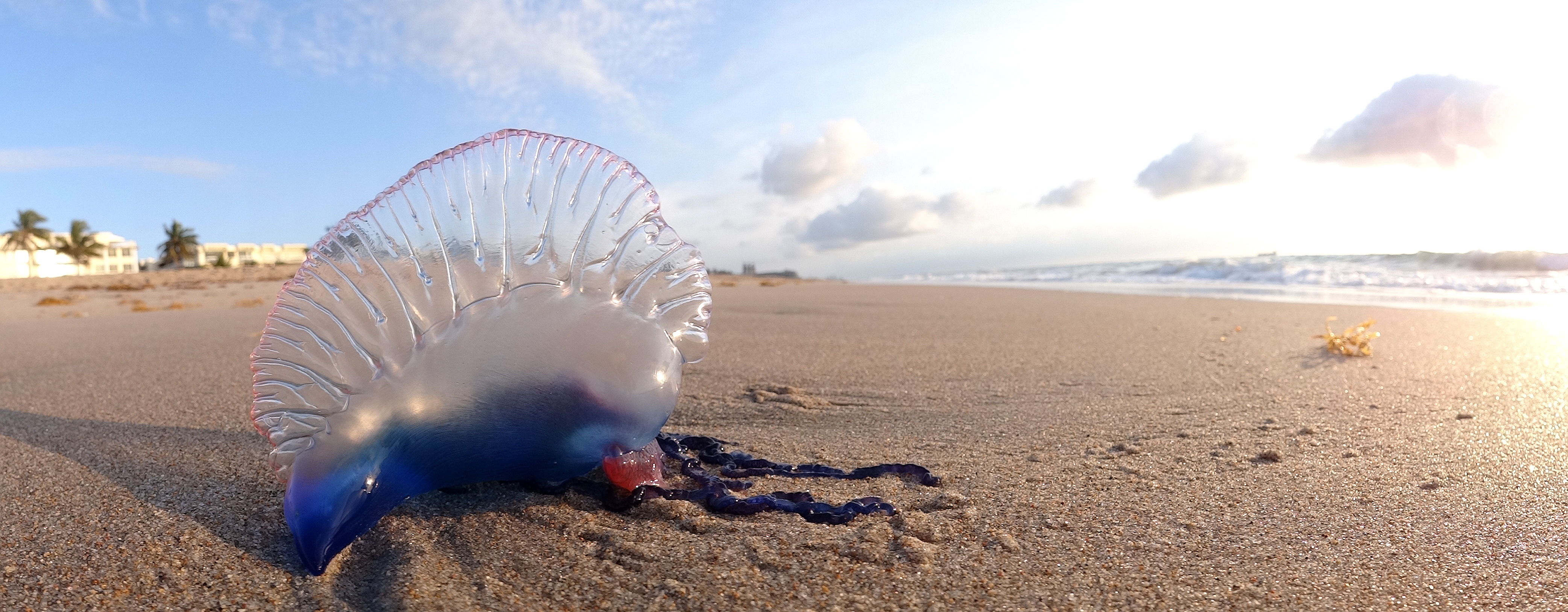
Portuguese man o' war
Physalia physalis
Portuguese man o' war
It isn't a jellyfish at all but a floating colony of thousands of microscopic individuals sharing one translucent sail, trailing venomous tentacles that can kill a fish in seconds.
🌊 0–50 m
- ⚡ A 'colony-individual': thousands of specialized clones fused into one floating organism
- ⚡ Venom that keeps stinging weeks after the animal has died
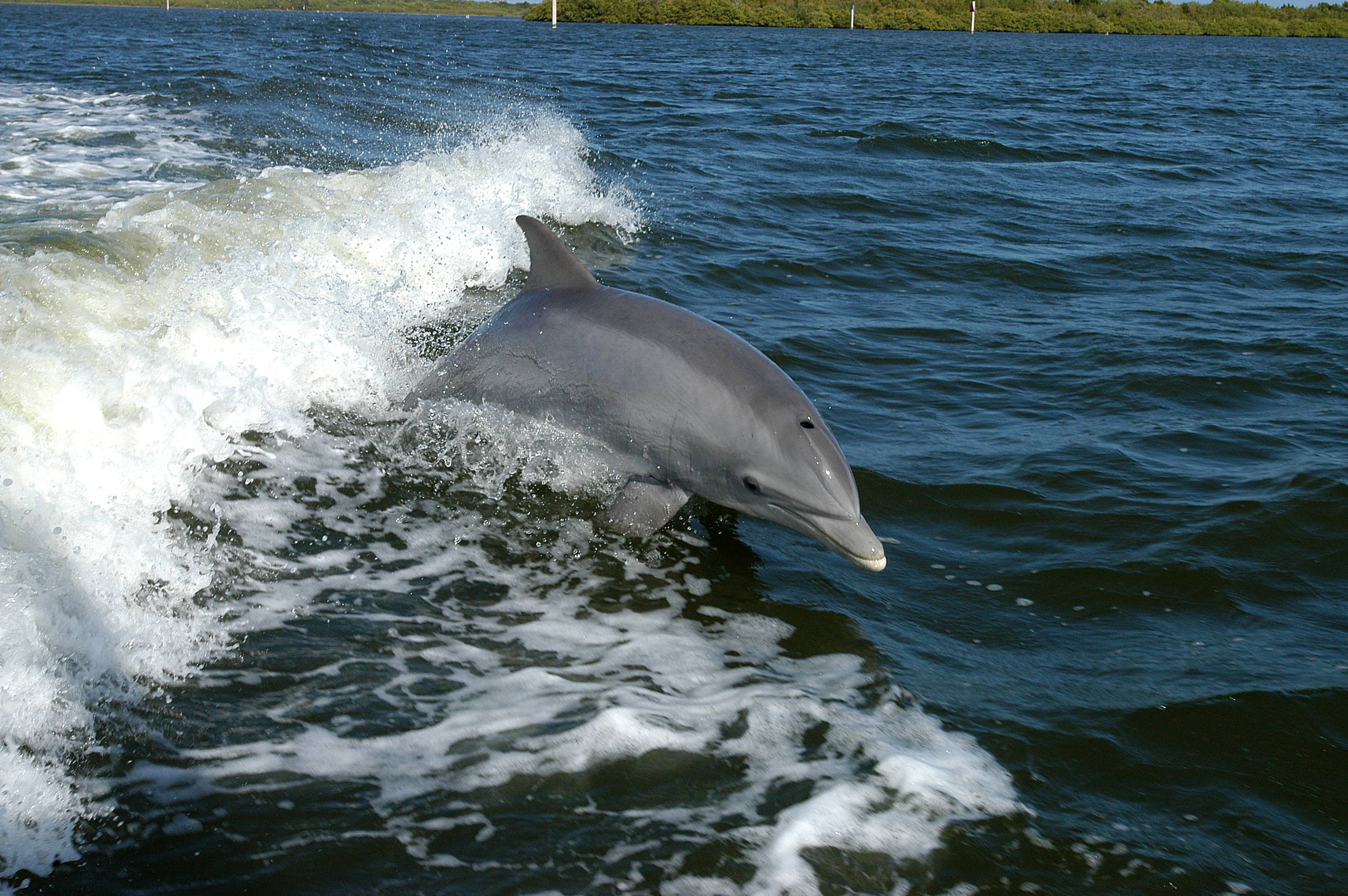
Common bottlenose dolphin
Tursiops truncatus
Common bottlenose dolphin
Intelligent, playful, and capable of recognizing its own reflection, the bottlenose dolphin communicates through a unique 'signature whistle' that functions almost like a name.
🌊 0–400 m
- ⚡ A unique 'signature whistle' per individual, used like a name for its entire life
- ⚡ Echolocation so precise it can detect a fish buried under sand

Oyster toadfish
Opsanus tau
Oyster toadfish
Able to produce a low, sustained call to attract females, it is also one of the toughest fish on the coast, able to survive several hours out of water.
🌊 0–40 m
- ⚡ Can produce a call audible out of water thanks to muscles vibrating up to 200 times per second
- ⚡ Can survive several hours out of water thanks to skin that limits dehydration

Giant Pacific octopus
Enteroctopus dofleini
Giant Pacific octopus
Long feared as the "devilfish" in the legends of Indigenous peoples of the North American Pacific coast, this largest known octopus in the world turns out to be remarkably intelligent, able to open jars and recognise individual humans.
🌊 0–1500 m
- ⚡ Has nine brains, one central and one in each of its eight arms, able to act almost independently
- ⚡ Intelligence documented in the lab: able to open jars and recognise certain individual humans

Spotted eagle ray
Aetobatus ocellatus
Spotted eagle ray
Gliding like a silent flight over the sand with wings dotted in white, this ray unearths molluscs and crustaceans with a single sweep of its duck-like snout.
🌊 1–80 m
- ⚡ A sensory 'radar' in its snout that can detect prey buried under the sand
- ⚡ Leaps clear out of the water that can exceed a meter in height

Common cuttlefish
Sepia officinalis
Common cuttlefish
A true chameleon of the sea, the common cuttlefish can change color and skin texture in a fraction of a second, thanks to thousands of pigment cells wired directly to its brain.
🌊 0–200 m
- ⚡ Changes skin color and texture in a fraction of a second using thousands of chromatophores individually controlled by the brain
- ⚡ Detects polarized light with extreme sensitivity — a sensory ability humans entirely lack

Scalloped hammerhead shark
Sphyrna lewini
Scalloped hammerhead shark
Its hammer-shaped head, the cephalofoil, is an extraordinary biological radar, studded with electrical sensors able to detect prey buried in the sand.
🌊 0–80 m
- ⚡ Ultra-sensitive electroreception via ampullae of Lorenzini spread across its cephalofoil
- ⚡ Near-360° panoramic vision

Green sea turtle
Chelonia mydas
Green sea turtle
The only sea turtle that is strictly herbivorous as an adult, the green turtle can travel thousands of kilometers just to return and nest on the exact beach where it hatched.
🌊 0–40 m
- ⚡ An internal magnetic 'compass' that lets it find its way back to its birth beach after years at sea
- ⚡ The only sea turtle that is strictly vegetarian as an adult, playing a key role in keeping the seagrass meadows it grazes healthy

Bobbit worm
Eunice aphroditois
Bobbit worm
Buried in the sand and invisible, this predatory worm waits for months before striking in a fraction of a second, slicing a fish clean in two with its jaws.
🌊 1–200 m
- ⚡ A lightning strike capable of slicing a fish clean in two instantly
- ⚡ Total camouflage: invisible under the sand, it can wait for months before attacking

Peacock mantis shrimp
Odontodactylus scyllarus
Peacock mantis shrimp
A reef crustacean able to strike with such speed and force that it can crack an aquarium's glass — one of the fastest movements in the animal kingdom.
🌊 0–40 m
- ⚡ One of the fastest, most powerful strikes in the animal kingdom (acceleration comparable to a bullet)
- ⚡ Unique vision able to perceive polarised light and ultraviolet

Swordfish
Xiphias gladius
Swordfish
Its sharp bill, as long as a sword, lets it strike prey at full speed, making it one of the fastest fish in the ocean.
🌊 30–180 m
- ⚡ Actively warms its eyes and brain thanks to a unique thermogenic organ
- ⚡ Among the fastest fish in the ocean thanks to its hydrodynamic body and bill

Grooved brain coral
Diploria labyrinthiformis
Grooved brain coral
Beneath its motionless, brain-like surface lies a living colony of thousands of tiny animals, slowly building — millimeter by millimeter — an architecture centuries in the making.
🌊 1–30 m
- ⚡ Can live for centuries, ranking among the longest-lived animals on Earth, its skeleton built at barely 3.5 mm per year
- ⚡ Hosts millions of symbiotic algae inside its own tissue, harvesting sunlight like a plant while remaining a true animal

Giant oarfish
Regalecus glesne
Giant oarfish
In Japan it is nicknamed the "messenger from the palace of the dragon god", and its appearance near the coast is sometimes seen as an omen of an imminent earthquake — a legend science has never confirmed but which likely explains the origin of many sea-serpent tales.
🌊 20–1000 m
- ⚡ Can swim in a perfectly vertical, motionless position, rippling only its dorsal fin
- ⚡ Its rare, spectacular strandings have fuelled the sea-serpent legend for centuries

Loggerhead sea turtle
Caretta caretta
Loggerhead sea turtle
With a massive head and jaws strong enough to crush a whole conch shell, this ocean globetrotter returns, decades later, to the exact beach where it hatched — guided by a built-in magnetic compass.
🌊 0–60 m
- ⚡ Senses Earth's magnetic field to find its way back to its natal beach after thousands of kilometers of migration
- ⚡ A jaw powerful enough to crush shellfish no other sea turtle species can access