
Sharks
Frilled shark
Chlamydoselachus anguineus
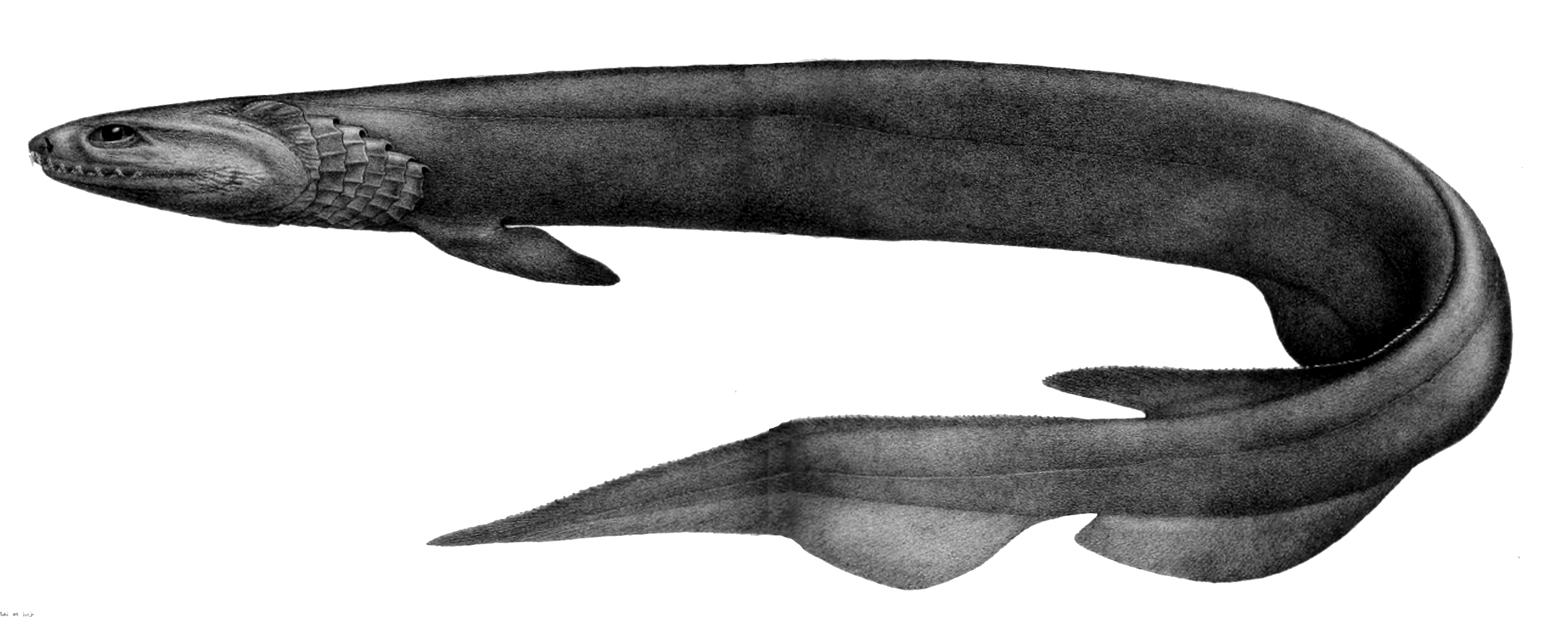
Nicknamed the "snake shark" or a living fossil, it has changed very little in 80 million years and resembles a giant eel with 300 needle-like teeth.
🗺️ Geographic range
Deep waters of the Atlantic and Pacific, notably off Japan, Norway and New Zealand.
📊 Population
No precise global population figure; listed as near threatened by the IUCN due to bycatch in deep-sea fisheries.
⚠️ Threats
Bycatch
Accidentally caught in deep-water fisheries targeting other species.
Source: IUCN — Red List of Threatened Species
Habitat
- Atlantic Ocean · High seas / open water · Mesopelagic zone · Permanent
Behaviour
- Diet
- Squid, fish and other sharks, caught with a jaw able to open extremely wide.
- Hunting
- Likely ambushes, its flexible body allowing it to lunge like a snake.
- Reproduction
- The longest known gestation of any vertebrate: about 3.5 years.
Physiology
- Anatomy
- An elongated, eel-like body, six pairs of frilled gill slits that give the species its name.
- Adaptations
- Highly mobile jaws bearing about 300 needle-like, recurved teeth arranged in 25 rows.
🔗 Web of marine life
Prey
⚡ Its extraordinary abilities
- Considered a living fossil, virtually unchanged for 80 million years
- The longest known gestation period of any vertebrate: about 3.5 years
🏆 Records
The longest known gestation in any vertebrate
About 3.5 years, compared with 9 months in humans.
Source: French National Museum of Natural History
If you cross paths with this animal…
Risk: Low: lives too deep to cross paths with humans, caught only accidentally by trawls.
Behaviour: Almost never observed alive in its natural habitat.
Advice: Its rarity still fuels "sea serpent" legends today.
💡 Did you know?
- Its appearance has inspired several sea-serpent legends after accidental catches by fishermen.
- A living specimen was filmed in its natural habitat for the first time only in 2004.