Coral reef
One of the most biodiverse ecosystems on the planet, built by colonies of coral.

Giant carpet anemone
Heteractis magnifica
Giant carpet anemone
Host to many clownfish that are immune to its own sting, it can live for decades in the same spot without ever moving.
🌊 0–20 m
- ⚡ Can live for decades in the same spot without ever moving
- ⚡ Maintains a symbiosis with the clownfish, which in turn protects it from certain predators

Hermit crab
Coenobita sp.
Hermit crab
Unable to build its own shell, it spends its life squatting in abandoned ones, trading up for a bigger one as it grows — sometimes in genuine collective exchange chains.
🌊 0–10 m
- ⚡ Can organise a shell-exchange chain among several individuals of different sizes
- ⚡ Some species live almost entirely on land while still depending on the ocean to reproduce

Peacock mantis shrimp
Odontodactylus scyllarus
Peacock mantis shrimp
A reef crustacean able to strike with such speed and force that it can crack an aquarium's glass — one of the fastest movements in the animal kingdom.
🌊 0–40 m
- ⚡ One of the fastest, most powerful strikes in the animal kingdom (acceleration comparable to a bullet)
- ⚡ Unique vision able to perceive polarised light and ultraviolet

Crown-of-thorns starfish
Acanthaster planci
Crown-of-thorns starfish
Able to devour an entire coral reef within months during massive outbreaks, it is also one of the few starfish with genuinely venomous spines.
🌊 0–30 m
- ⚡ Can regenerate a whole individual from a fragment of its body
- ⚡ Can devour an entire coral reef within months during a massive outbreak

Bargibant's pygmy seahorse
Hippocampus bargibanti
Bargibant's pygmy seahorse
No bigger than a fingernail, this tiny seahorse lives exclusively on a single species of soft coral, whose colour and bumps it mimics perfectly.
🌊 10–40 m
- ⚡ Camouflage so perfect it was discovered by accident, in a lab, on coral already collected for study
- ⚡ The male carries and hatches the eggs, one of the rare parental-role reversals in the animal kingdom
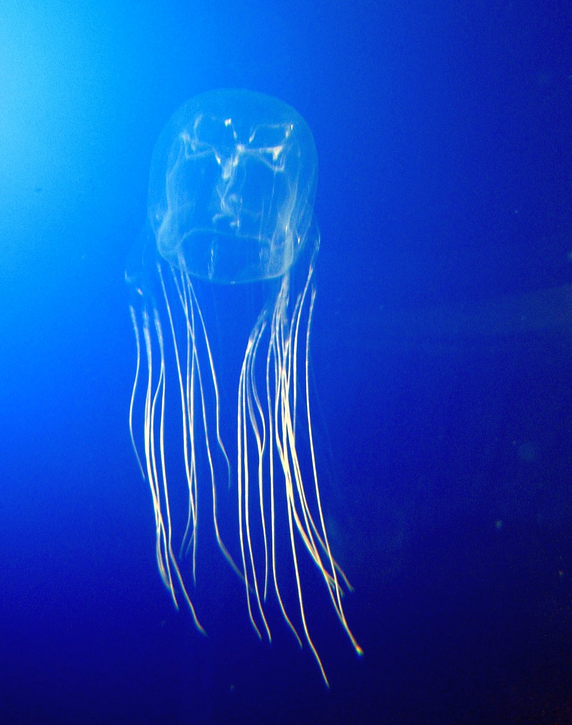
Box jellyfish
Chironex fleckeri
Box jellyfish
Considered one of the most venomous creatures in the sea, its tentacles carry a venom able to trigger cardiac arrest in humans within minutes.
🌊 0–20 m
- ⚡ Has up to 24 eyes, some able to form a true image
- ⚡ One of the fastest, most potent venoms in the animal kingdom
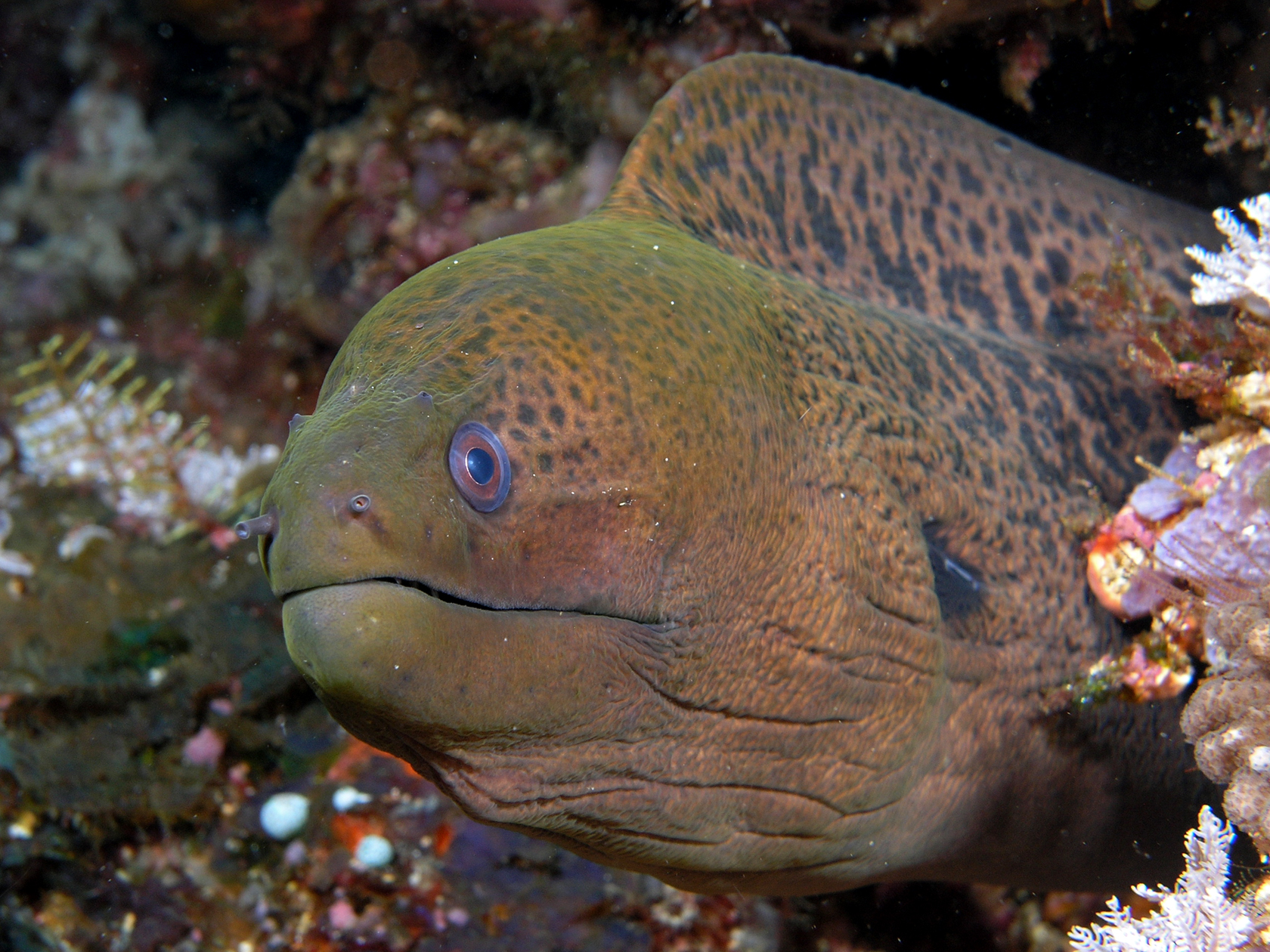
Giant moray
Gymnothorax javanicus
Giant moray
Often perceived as menacing because of its half-open mouth, it simply breathes that way — and hides a second, retractable jaw worthy of a science-fiction film.
🌊 0–50 m
- ⚡ Has a second, retractable jaw that shoots into its throat to seize prey
- ⚡ Sometimes hunts as a team with groupers, a rare inter-species cooperation among fish

Diadem sea urchin
Diadema setosum
Diadem sea urchin
Its long, thin black spines, able to break off and remain lodged in the skin, make it one of the sea urchins divers fear most, despite its essential ecological role.
🌊 0–40 m
- ⚡ Its entire body is light-sensitive, acting like one giant, distributed eye
- ⚡ Plays an essential role in controlling algae populations on coral reefs

Blue-ringed octopus
Hapalochlaena lunulata
Blue-ringed octopus
Tiny and unassuming, it is one of the most venomous animals in the sea: its fluorescent blue rings are a warning to be taken very seriously.
🌊 0–20 m
- ⚡ Venom (tetrodotoxin) among the most powerful in the animal kingdom, with no known antidote
- ⚡ Bioluminescent-style rings that can flash in a fraction of a second

Clownfish
Amphiprion ocellaris
Clownfish
Immune to the venom of the anemone that hosts it, it spends its entire life in one spot, and can literally change sex if the group's female disappears.
🌊 1–15 m
- ⚡ Immune to the anemone's stinging tentacles thanks to a protective mucus
- ⚡ Sequential hermaphroditism: born male, can become the dominant female

Crocodilefish
Papilloculiceps longiceps
Crocodilefish
Elongated and flattened like a submerged log, it spends most of its time motionless on the sand, its bulging eyes the only clue to attentive divers of its presence.
🌊 1–100 m
- ⚡ Camouflage so perfect it is often mistaken for a piece of debris or a submerged log
- ⚡ Eyes able to move independently to scan its surroundings without moving
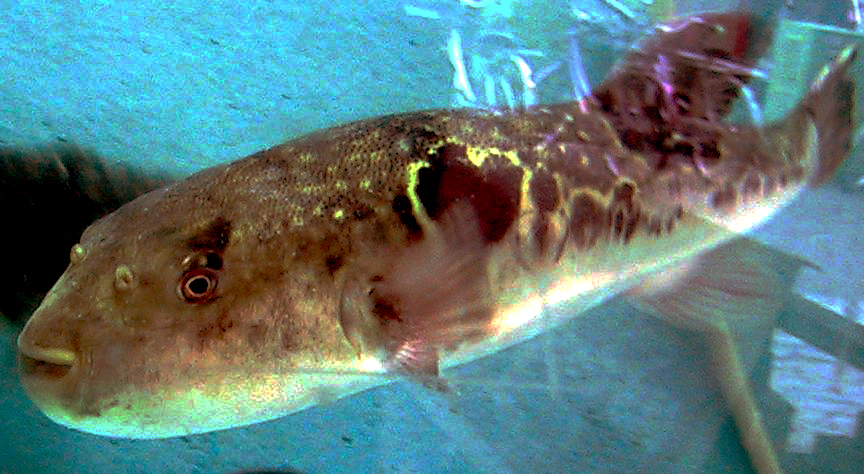
Pufferfish (fugu)
Takifugu rubripes
Pufferfish (fugu)
As famous as a Japanese delicacy as it is feared as a poison, its preparation in the kitchen is reserved for specially certified chefs, since its toxin can be fatal if a mistake is made.
🌊 0–50 m
- ⚡ Can double in size within seconds by swallowing water
- ⚡ A toxin so powerful that its culinary preparation requires specific certification in Japan

Lionfish
Pterois volitans
Lionfish
As spectacular as it is fearsome, its long venomous fan-like fins conceal a species that has become one of the greatest invasive threats to Caribbean reefs.
🌊 0–50 m
- ⚡ Venomous fins fanned out to intimidate and defend itself
- ⚡ A voracious appetite that fuelled a record invasion of the Atlantic and the Caribbean

Stonefish
Synanceia verrucosa
Stonefish
Considered the most venomous fish in the world, it blends perfectly with rocks and dead coral, making it nearly impossible to spot until it's too late.
🌊 0–30 m
- ⚡ Near-perfect camouflage, blending in with an algae-covered rock
- ⚡ One of the most powerful venoms known in any fish

Mimic octopus
Thaumoctopus mimicus
Mimic octopus
Able to imitate the appearance and behaviour of some fifteen different species, including venomous fish and sea snakes, to fool its predators.
🌊 0–25 m
- ⚡ Able to imitate the appearance of about fifteen different species, including venomous fish
- ⚡ Chooses which species to mimic based on the predator detected nearby

Scalloped hammerhead shark
Sphyrna lewini
Scalloped hammerhead shark
Its hammer-shaped head, the cephalofoil, is an extraordinary biological radar, studded with electrical sensors able to detect prey buried in the sand.
🌊 0–80 m
- ⚡ Ultra-sensitive electroreception via ampullae of Lorenzini spread across its cephalofoil
- ⚡ Near-360° panoramic vision

Giant triton
Charonia tritonis
Giant triton
Named after Triton, the sea's messenger god in Greek mythology who blew a conch shell to calm or unleash the waves, this huge sea snail is also one of the few natural predators able to keep crown-of-thorns starfish outbreaks in check on coral reefs.
🌊 0–30 m
- ⚡ One of the only natural predators able to keep devastating crown-of-thorns starfish outbreaks in check
- ⚡ Its shell has served for millennia as a ceremonial wind instrument in many Pacific cultures