Cnidarians
Box jellyfish
Chironex fleckeri
High danger🌊 0–20 m📏 up to 30 cmIUCN status: Not evaluated
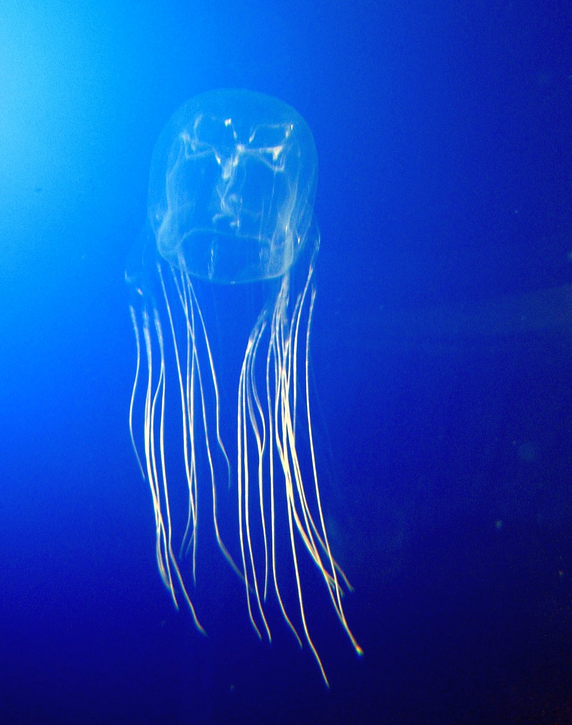
Considered one of the most venomous creatures in the sea, its tentacles carry a venom able to trigger cardiac arrest in humans within minutes.
🗺️ Geographic range
Coastal waters of northern Australia and the Indo-Pacific.
📊 Population
No population estimate available; common in warm season off northern Australia, not evaluated by the IUCN.
Habitat
- Pacific Ocean · Coral reef · Epipelagic zone · Permanent
Behaviour
- Diet
- Small fish and shrimp, instantly paralysed by the venom.
- Hunting
- Unlike most jellyfish, it swims actively and has eyes able to detect obstacles.
- Reproduction
- A complex cycle alternating between a fixed polyp stage and a free-swimming jellyfish stage.
Physiology
- Anatomy
- A nearly invisible transparent bell, with up to 15 tentacles at each corner.
- Adaptations
- Stinging cells (cnidocytes) among the most toxic known, injecting venom in a fraction of a second on contact.
🔗 Web of marine life
Predators
⚡ Its extraordinary abilities
- Has up to 24 eyes, some able to form a true image
- One of the fastest, most potent venoms in the animal kingdom
🏆 Records
One of the most venomous marine animals for humans
Its venom can be fatal within minutes without treatment.
Source: Australian Museum
If you cross paths with this animal…
Risk: High: contact can potentially be fatal within minutes.
Behaviour: Invisible in murky water, hard to spot.
Advice: Wear a protective suit in risk areas and keep vinegar on hand in case of contact.
💡 Did you know?
- Its venom can trigger cardiac arrest in humans within just a few minutes.
- Despite having no brain, it swims actively and avoids obstacles using its eyes.