
Fish
Giant moray
Gymnothorax javanicus
Low danger🌊 0–50 m📏 up to 300 cmIUCN status: Least concern
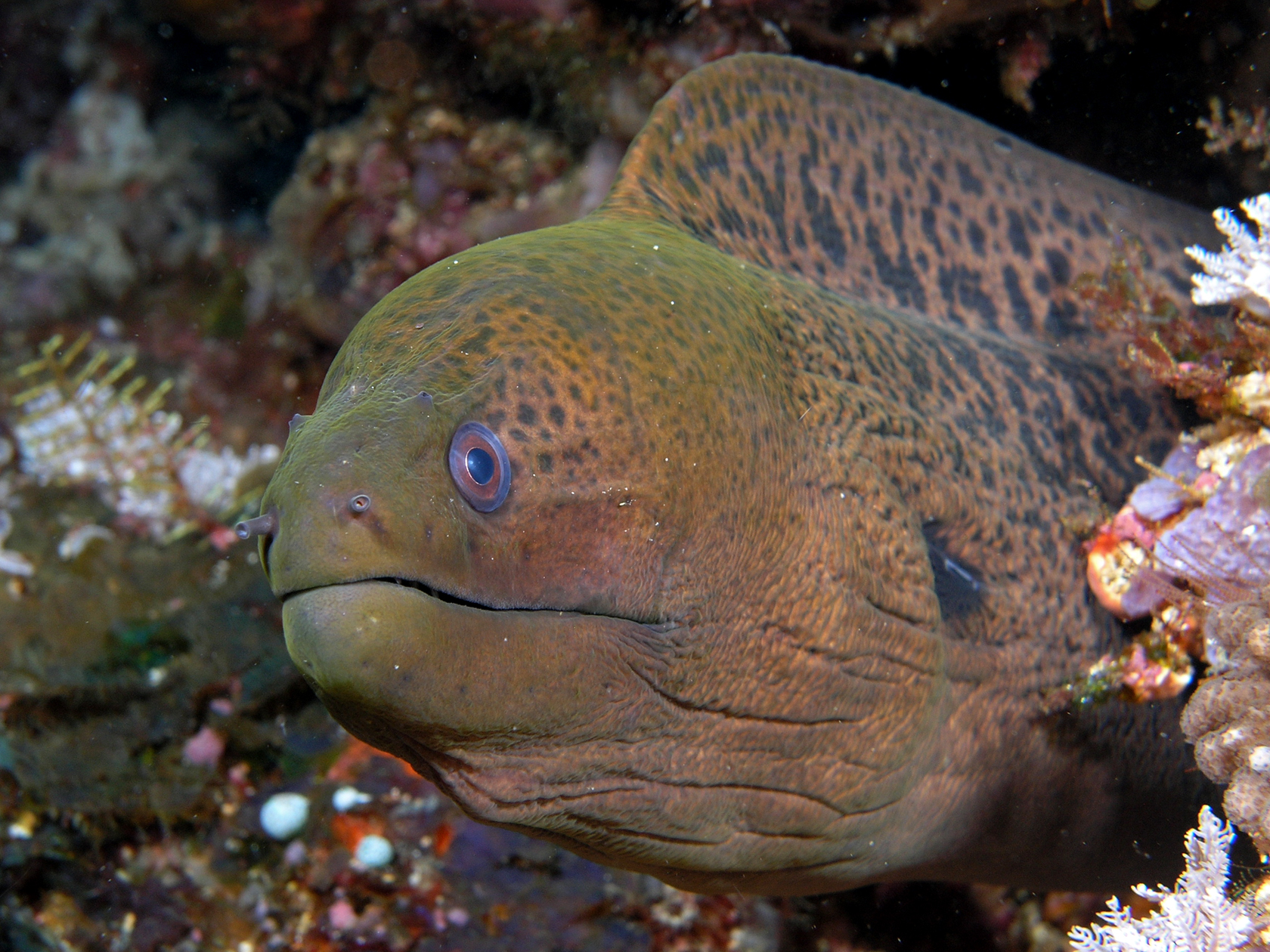
Often perceived as menacing because of its half-open mouth, it simply breathes that way — and hides a second, retractable jaw worthy of a science-fiction film.
🗺️ Geographic range
Coral reefs of the Indo-Pacific, from the Red Sea to Polynesia.
📊 Population
Not threatened and widespread across Indo-Pacific reefs (IUCN, least concern).
Habitat
- Indian Ocean · Coral reef · Epipelagic zone · Permanent
- Red Sea · Coral reef · Epipelagic zone · Permanent
Behaviour
- Diet
- Fish and octopuses, caught by surprise from a rocky crevice.
- Hunting
- Ambushes, sometimes hunting cooperatively with groupers.
- Reproduction
- Spawns in open water, with transparent pelagic larvae.
Physiology
- Anatomy
- A serpentine body, thick scaleless skin.
- Adaptations
- A second jaw, called pharyngeal, shoots into the throat to pull prey toward the stomach.
🔗 Web of marine life
⚡ Its extraordinary abilities
- Has a second, retractable jaw that shoots into its throat to seize prey
- Sometimes hunts as a team with groupers, a rare inter-species cooperation among fish
🏆 Records
One of the largest known moray eels
Can exceed 3 metres in length.
If you cross paths with this animal…
Risk: Low: a bite is possible only if disturbed or hand-fed.
Behaviour: Territorial but not aggressive toward respectful divers.
Advice: Never slide your hand into an unknown rocky crevice.
💡 Did you know?
- Its permanently half-open mouth is just a way of breathing, not a sign of aggression.
- Sometimes hunts cooperatively with groupers to flush out hidden prey.