
Fish
Silo of fish species, cartilaginous and bony.

Pelican eel
Eurypharynx pelecanoides
Pelican eel
Equipped with an oversized mouth able to stretch to swallow prey far larger than itself, it compensates for poor eyesight with a bioluminescent tail used as a lure.
🌊 500–3000 m
- ⚡ Can swallow prey far larger than itself thanks to an extensible stomach
- ⚡ Has a light organ at the tip of its tail used as a lure
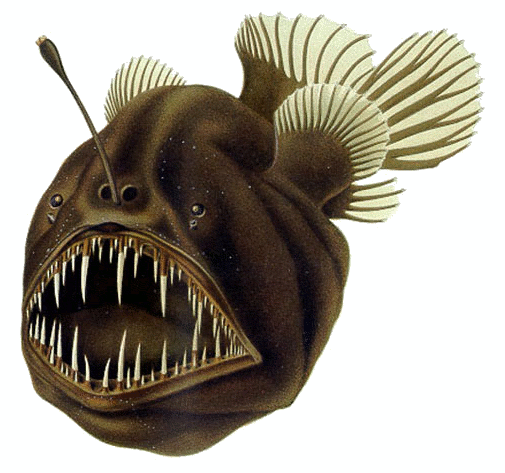
Humpback anglerfish
Melanocetus johnsonii
Humpback anglerfish
Hunts in total darkness using a bioluminescent lure dangling above its mouth, and practises one of the strangest reproductive strategies in the animal kingdom: the tiny male ends up fusing with the female.
🌊 300–1200 m
- ⚡ Fishes with a bioluminescent lure produced by symbiotic bacteria
- ⚡ Extreme sexual parasitism: the male fuses physically and vascularly with the female

Coelacanth
Latimeria chalumnae
Coelacanth
Believed extinct for 65 million years, alongside the dinosaurs, until its spectacular rediscovery in 1938 off South Africa.
🌊 150–700 m
- ⚡ Believed extinct for 65 million years until its rediscovery in 1938
- ⚡ Fleshy fins that move like limbs, close to the ancestor of the first land vertebrates

Leafy seadragon
Phycodurus eques
Leafy seadragon
A fish that looks exactly like a drifting piece of seaweed — the most spectacular camouflage in temperate marine wildlife.
🌊 3–50 m
- ⚡ Near-perfect camouflage mimicking the surrounding seaweed
- ⚡ The male carries and protects the eggs until they hatch

Swordfish
Xiphias gladius
Swordfish
Its sharp bill, as long as a sword, lets it strike prey at full speed, making it one of the fastest fish in the ocean.
🌊 30–180 m
- ⚡ Actively warms its eyes and brain thanks to a unique thermogenic organ
- ⚡ Among the fastest fish in the ocean thanks to its hydrodynamic body and bill

Bargibant's pygmy seahorse
Hippocampus bargibanti
Bargibant's pygmy seahorse
No bigger than a fingernail, this tiny seahorse lives exclusively on a single species of soft coral, whose colour and bumps it mimics perfectly.
🌊 10–40 m
- ⚡ Camouflage so perfect it was discovered by accident, in a lab, on coral already collected for study
- ⚡ The male carries and hatches the eggs, one of the rare parental-role reversals in the animal kingdom
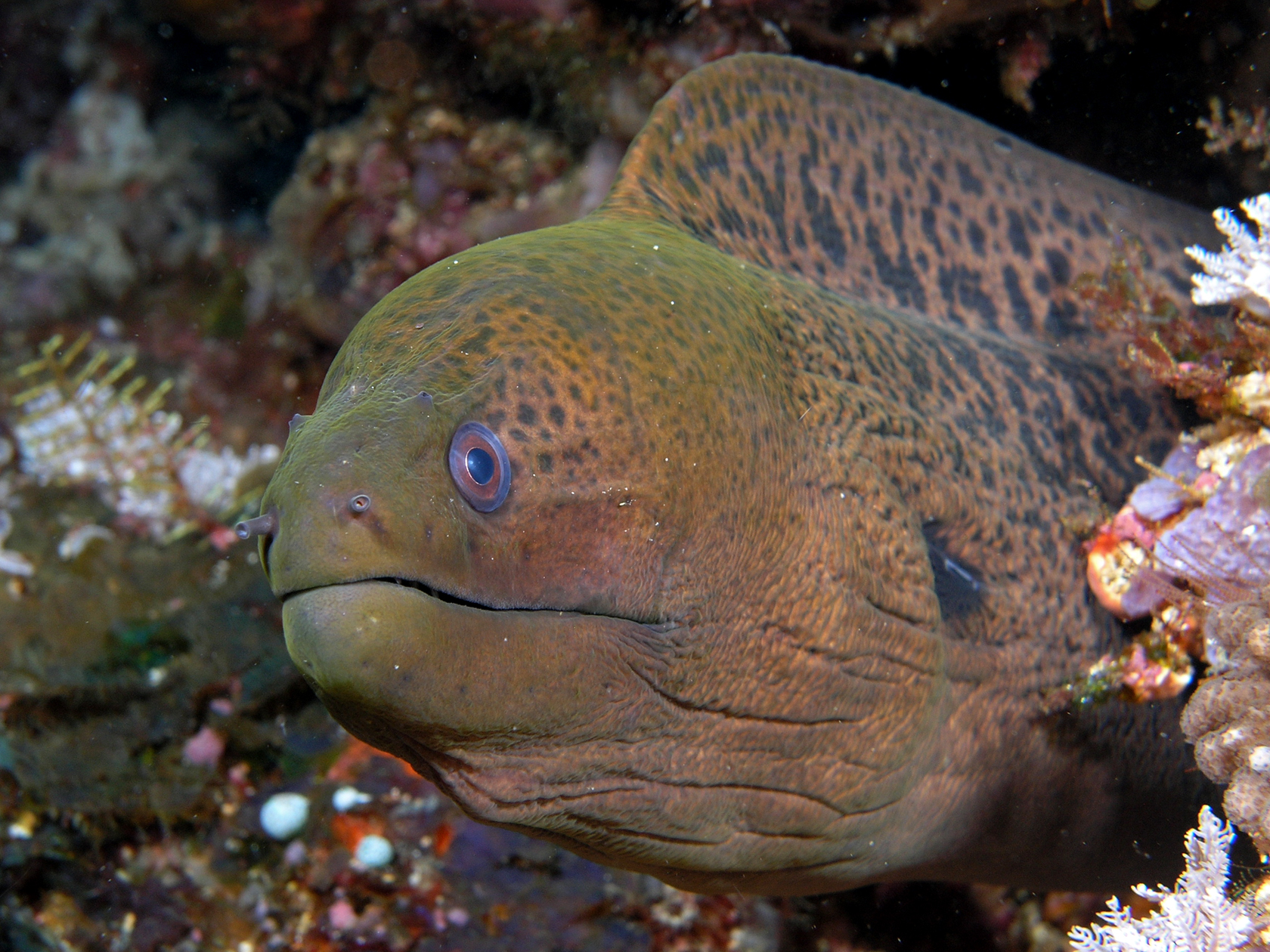
Giant moray
Gymnothorax javanicus
Giant moray
Often perceived as menacing because of its half-open mouth, it simply breathes that way — and hides a second, retractable jaw worthy of a science-fiction film.
🌊 0–50 m
- ⚡ Has a second, retractable jaw that shoots into its throat to seize prey
- ⚡ Sometimes hunts as a team with groupers, a rare inter-species cooperation among fish

Clownfish
Amphiprion ocellaris
Clownfish
Immune to the venom of the anemone that hosts it, it spends its entire life in one spot, and can literally change sex if the group's female disappears.
🌊 1–15 m
- ⚡ Immune to the anemone's stinging tentacles thanks to a protective mucus
- ⚡ Sequential hermaphroditism: born male, can become the dominant female
Oyster toadfish
Opsanus tau
Oyster toadfish
Able to produce a low, sustained call to attract females, it is also one of the toughest fish on the coast, able to survive several hours out of water.
🌊 0–40 m
- ⚡ Can produce a call audible out of water thanks to muscles vibrating up to 200 times per second
- ⚡ Can survive several hours out of water thanks to skin that limits dehydration

Crocodilefish
Papilloculiceps longiceps
Crocodilefish
Elongated and flattened like a submerged log, it spends most of its time motionless on the sand, its bulging eyes the only clue to attentive divers of its presence.
🌊 1–100 m
- ⚡ Camouflage so perfect it is often mistaken for a piece of debris or a submerged log
- ⚡ Eyes able to move independently to scan its surroundings without moving
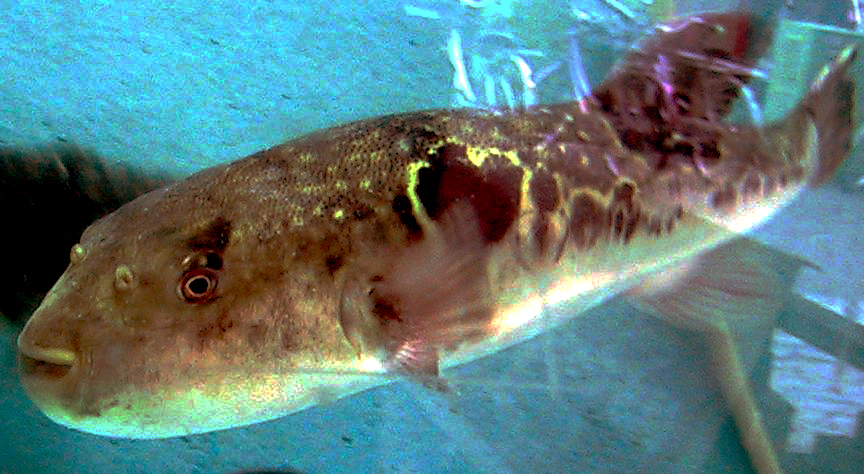
Pufferfish (fugu)
Takifugu rubripes
Pufferfish (fugu)
As famous as a Japanese delicacy as it is feared as a poison, its preparation in the kitchen is reserved for specially certified chefs, since its toxin can be fatal if a mistake is made.
🌊 0–50 m
- ⚡ Can double in size within seconds by swallowing water
- ⚡ A toxin so powerful that its culinary preparation requires specific certification in Japan
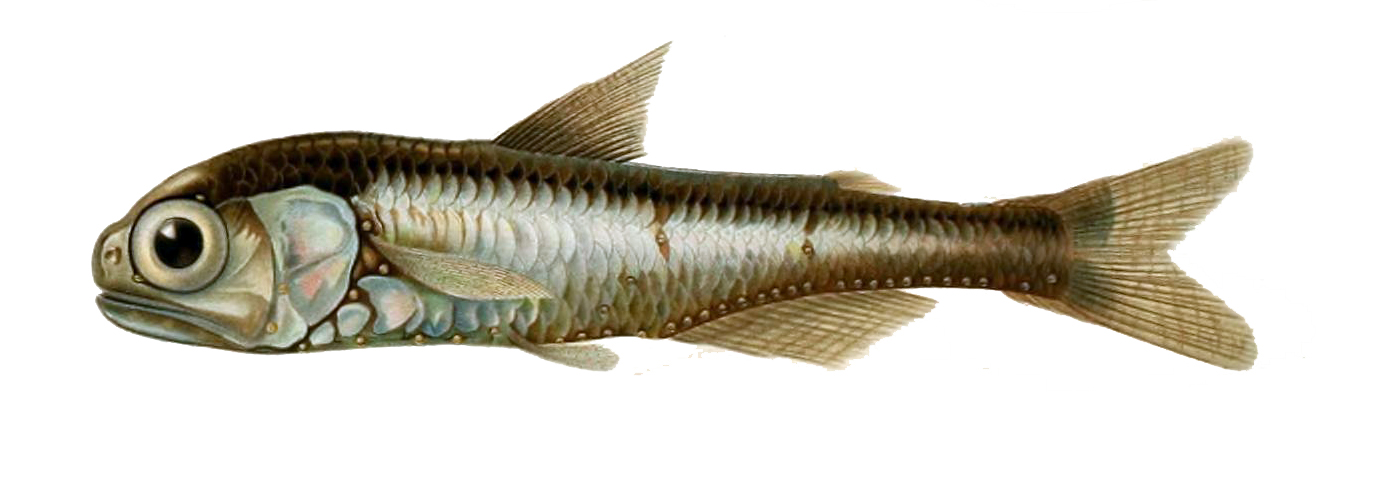
Lanternfish
Myctophum punctatum
Lanternfish
One of the most abundant fish in the ocean: every night it rises from the depths to feed near the surface, then dives back at dawn — a planet-wide daily migration.
🌊 10–700 m
- ⚡ Counter-illumination: its photophores mimic daylight to make it invisible from below
- ⚡ Undertakes one of the planet's largest animal migrations by biomass, every single day
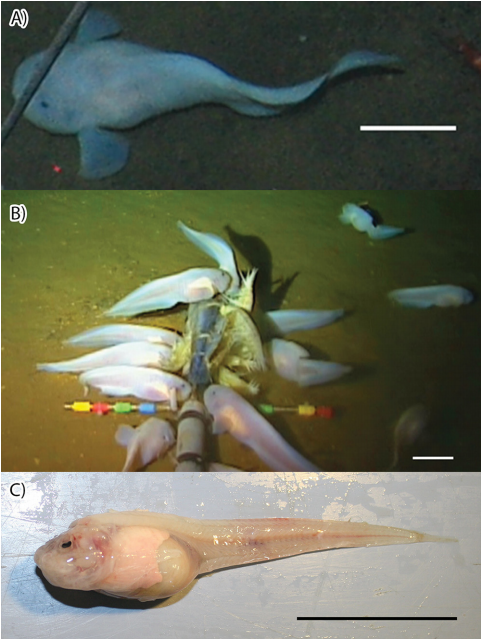
Mariana snailfish
Pseudoliparis swirei
Mariana snailfish
The deepest-living fish ever confirmed, discovered in 2014 and formally described in 2017 in the Mariana Trench, at nearly 8,000 m below the surface.
🌊 6198–8076 m
- ⚡ The deepest-living fish ever confirmed, down to about 8,000 m
- ⚡ Its cells are protected from being crushed by a molecule (TMAO) that stabilises its proteins under extreme pressure

Lionfish
Pterois volitans
Lionfish
As spectacular as it is fearsome, its long venomous fan-like fins conceal a species that has become one of the greatest invasive threats to Caribbean reefs.
🌊 0–50 m
- ⚡ Venomous fins fanned out to intimidate and defend itself
- ⚡ A voracious appetite that fuelled a record invasion of the Atlantic and the Caribbean

Stonefish
Synanceia verrucosa
Stonefish
Considered the most venomous fish in the world, it blends perfectly with rocks and dead coral, making it nearly impossible to spot until it's too late.
🌊 0–30 m
- ⚡ Near-perfect camouflage, blending in with an algae-covered rock
- ⚡ One of the most powerful venoms known in any fish

Giant oarfish
Regalecus glesne
Giant oarfish
In Japan it is nicknamed the "messenger from the palace of the dragon god", and its appearance near the coast is sometimes seen as an omen of an imminent earthquake — a legend science has never confirmed but which likely explains the origin of many sea-serpent tales.
🌊 20–1000 m
- ⚡ Can swim in a perfectly vertical, motionless position, rippling only its dorsal fin
- ⚡ Its rare, spectacular strandings have fuelled the sea-serpent legend for centuries

Atlantic bluefin tuna
Thunnus thynnus
Atlantic bluefin tuna
One of the fastest fish in the ocean, able to keep its muscles warmer than the surrounding water to cross the Atlantic during its migrations.
🌊 0–250 m
- ⚡ Can keep its muscle temperature above that of the surrounding water (regional endothermy)
- ⚡ Top speed among the highest of all bony fish