
Fish
Humpback anglerfish
Melanocetus johnsonii
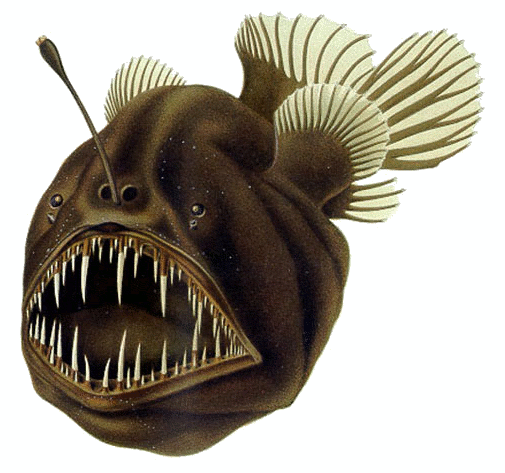
Hunts in total darkness using a bioluminescent lure dangling above its mouth, and practises one of the strangest reproductive strategies in the animal kingdom: the tiny male ends up fusing with the female.
🗺️ Geographic range
Tropical and temperate oceans worldwide, in deep water off the continents.
📊 Population
No population estimate available; a deep-sea species too little studied for an IUCN assessment.
Habitat
- Atlantic Ocean · High seas / open water · Mesopelagic zone · Permanent
Behaviour
- Diet
- Fish and crustaceans lured by the glowing lure, swallowed by an extensible mouth.
- Hunting
- Stays still, waiting for prey to approach the glowing lure (the esca).
- Reproduction
- The male, thousands of times smaller, bites the female and gradually fuses with her, sharing her blood supply.
Physiology
- Anatomy
- An oversized mouth, a gelatinous body, black skin absorbing any residual light.
- Adaptations
- A bioluminescent lure (illicium) housing light-producing bacteria.
🔗 Web of marine life
Prey
⚡ Its extraordinary abilities
- Fishes with a bioluminescent lure produced by symbiotic bacteria
- Extreme sexual parasitism: the male fuses physically and vascularly with the female
🏆 Records
One of the most extreme male/female size differences in the animal kingdom
The male can be thousands of times lighter than the female.
Source: French National Museum of Natural History
If you cross paths with this animal…
Risk: None: lives at depths completely inaccessible without a submersible.
Behaviour: Motionless, lying in ambush.
Advice: An icon of the abyss's strangest creatures, popularised by the film Finding Nemo.
💡 Did you know?
- The male, thousands of times lighter than the female, survives only by fusing with her.
- Inspired the frightening creature Nemo encounters in the deep.