
Fish
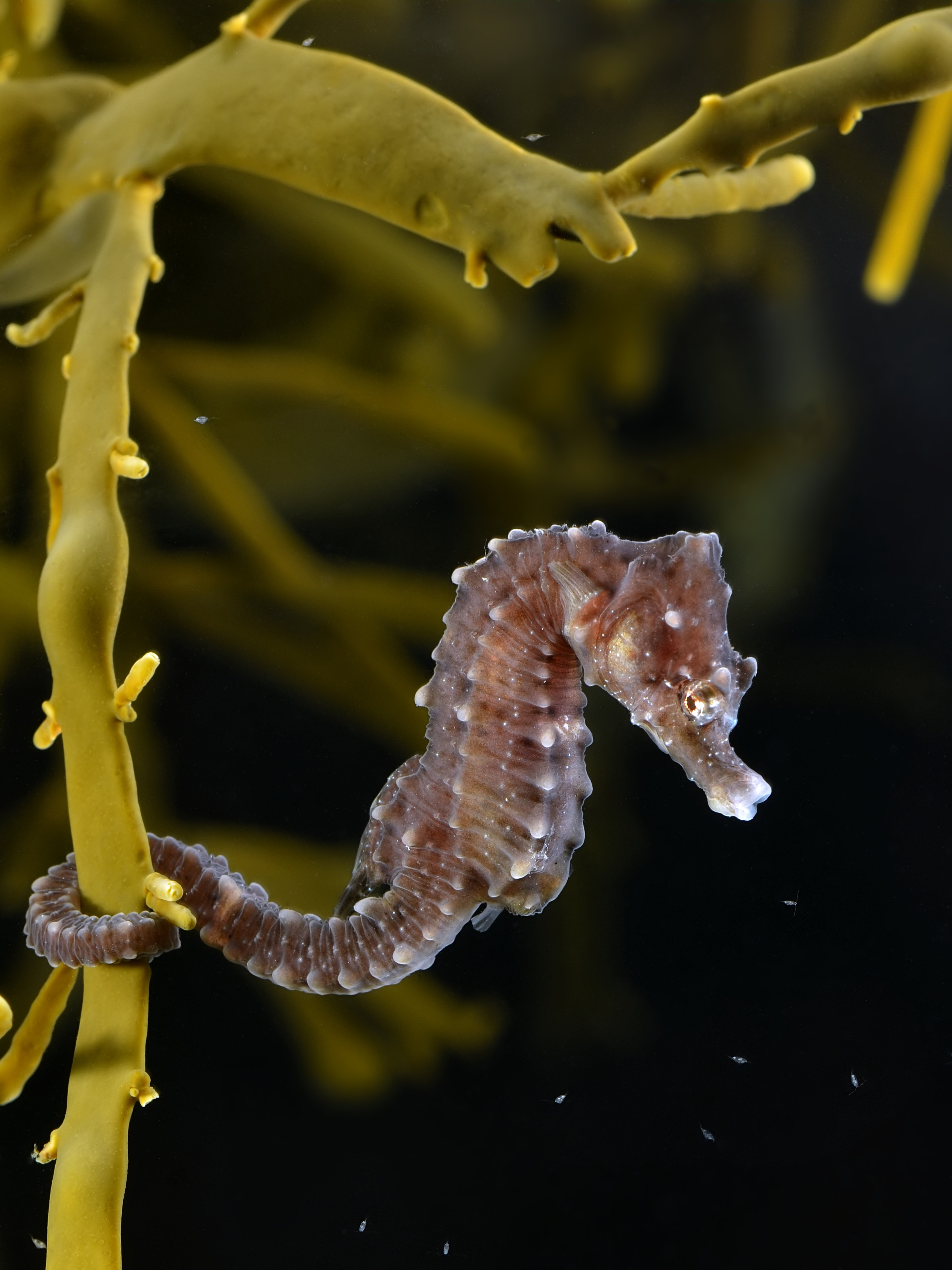
Short-snouted seahorse
Hippocampus hippocampus
Epipelagic zone
A tiny knight of the seagrass meadows, it is the male — not the female — who carries the eggs and gives birth, in one of the most striking role-reversals in the animal kingdom.
🗺️ Geographic range
Found in the eastern Atlantic, from the British Isles and southern North Sea down to the Canary Islands and Cape Verde, as well as the Mediterranean and Black Seas, in seagrass beds, estuaries, and shallow waters.
📊 Population
No reliable global population estimate exists (Data Deficient status), but concerning local declines are documented, for example in Portugal, linked to habitat loss (seagrass/algae), bycatch, and trade. Conversely, sightings are increasing at the northern edge of its range (Thames Estuary), possibly linked to warming waters.
Habitat
- Atlantic Ocean · Coral reef · Epipelagic zone · Permanent
🥚 Reproduction
The male carries the eggs (50 to 250) in a ventral brood pouch for about 20–21 days before giving live birth to juveniles.
Behaviour
- Diet
- An ambush predator of tiny crustaceans (copepods, mysid shrimp), consuming 30–50 prey per day.
- Hunting
- Stays motionless and camouflaged, then sucks in prey instantly through its tubular snout — it has neither teeth nor a stomach.
- Communication
- Courtship includes color changes, a 'dance' where partners link tails, and clicking sounds produced by skull structures.
- Social life
- Forms faithful pairs for a breeding season, but is otherwise rather solitary, anchored to plants by its prehensile tail.
Physiology
- Anatomy
- Body covered in ringed bony plates (not scales), no caudal fin, with a prehensile tail for gripping.
- Respiration
- Breathes via gills housed in small gill openings.
- Vision
- Its eyes move independently of each other, like a chameleon's, to watch for prey and predators at the same time.
- Adaptations
- Skin capable of changing color to blend into its surroundings, and swims upright using a dorsal fin that beats very rapidly for slow but precise movement.
🔗 Web of marine life
Partners
⚡ Its extraordinary abilities
- The male, not the female, becomes 'pregnant' and gives birth
- Each eye moves independently of the other, letting it watch two directions at once
🏆 Records
The only animal group where the male carries the pregnancy
Seahorses are the only animal group in which the male carries out the entire pregnancy and gives birth.
If you cross paths with this animal…
Risk: None — cannot harm a human in any way.
Behaviour: Extremely well camouflaged, a weak swimmer, anchored by its tail to seagrass or algae, and easily stressed by handling.
Advice: Never touch it or lift it out of the water for a photo — handling stress can be fatal to it; avoid anchoring boats on the seagrass beds where it lives.
💡 Did you know?
- It is one of the slowest-swimming fish in the ocean, yet it sucks in prey in a fraction of a second through a striking capture mechanism shared by all seahorses.
- It has no stomach, so it must eat almost continuously to survive.


