
Fish
Oyster toadfish
Opsanus tau
Low danger🌊 0–40 m📏 up to 43 cmIUCN status: Least concern
Able to produce a low, sustained call to attract females, it is also one of the toughest fish on the coast, able to survive several hours out of water.
🗺️ Geographic range
The Atlantic coast of North America, from Maine to the Gulf of Mexico.
📊 Population
Not threatened along the North American Atlantic coast (IUCN, least concern).
Habitat
- Atlantic Ocean · Epipelagic zone · Permanent
Behaviour
- Diet
- Crabs, molluscs, small fish, crushed by a powerful jaw.
- Hunting
- A motionless ambush, camouflaged among rocks and debris.
- Reproduction
- The male sings to attract females and guards the eggs until they hatch.
Physiology
- Anatomy
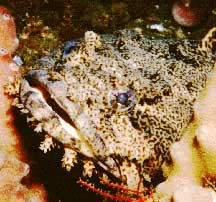
- A stocky body, slimy skin with no visible scales, a large mouth.
- Adaptations
- Sonic muscles among the fastest known in any vertebrate, contracting up to 200 times per second.
🔗 Web of marine life
Predators
⚡ Its extraordinary abilities
- Can produce a call audible out of water thanks to muscles vibrating up to 200 times per second
- Can survive several hours out of water thanks to skin that limits dehydration
If you cross paths with this animal…
Risk: Low, a painful bite is possible if handled.
Behaviour: Territorial but discreet.
Advice: Never slide a hand under a rock in an intertidal zone without caution.
💡 Did you know?
- Its mating call long puzzled locals who heard it from their moored boats.
- Can live several hours out of water, a record among coastal fish.