
Cnidarians
Portuguese man o' war
Physalia physalis
Epipelagic zone
It isn't a jellyfish at all but a floating colony of thousands of microscopic individuals sharing one translucent sail, trailing venomous tentacles that can kill a fish in seconds.
🗺️ Geographic range
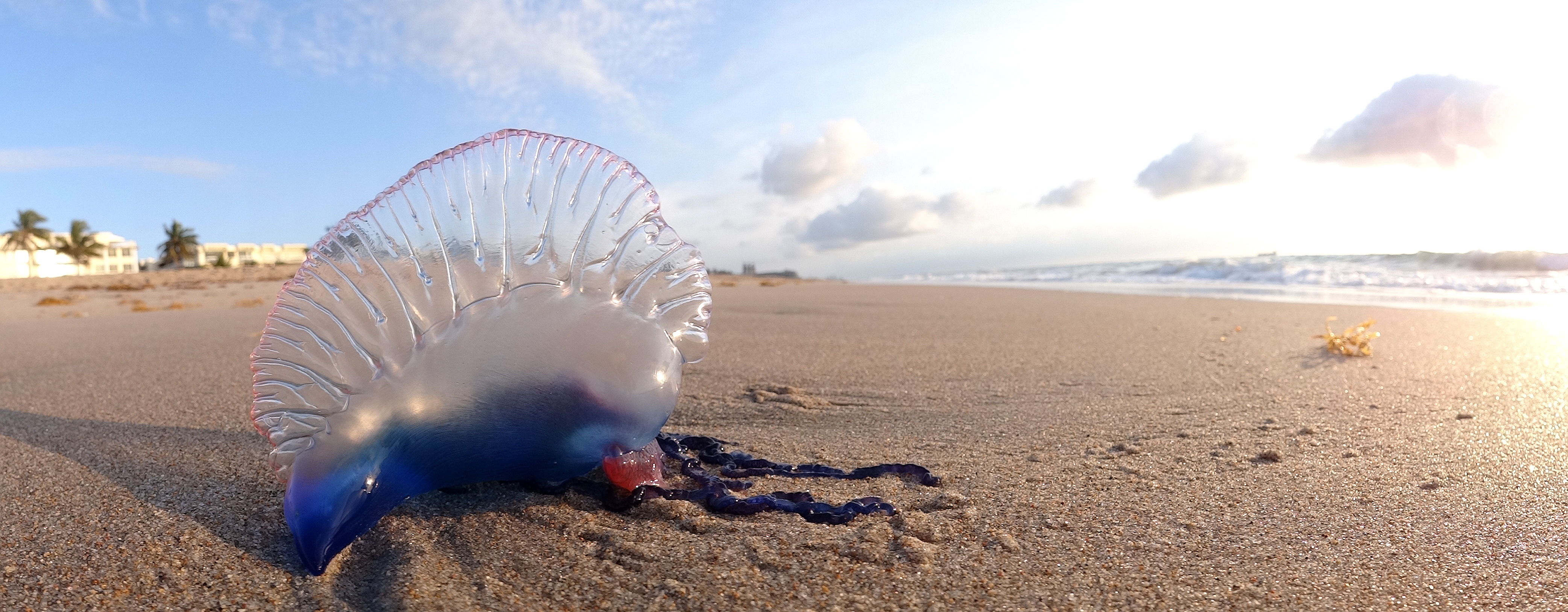
Found in tropical and subtropical waters across all oceans, the Portuguese man o' war does not swim under its own power — it drifts on wind and currents, which explains sudden mass strandings on beaches, sometimes in flotillas of 1,000 or more.
📊 Population
Not assessed by the IUCN, the man o' war is not threatened — if anything it is extremely abundant, and mass stranding events ('blooms') appear to be intensifying as wind patterns shift with climate change.
Habitat
- Atlantic Ocean · High seas / open water · Epipelagic zone · Permanent
🥚 Reproduction
Colonies are single-sex; they release sperm or eggs directly into the water, and fertilization has rarely been directly observed in the wild.
Behaviour
- Diet
- A carnivore, it captures small fish, crustaceans, and zooplankton using stinging cells (nematocysts) that inject a paralyzing venom.
- Hunting
- It never pursues its prey: it waits, tentacles deployed, for a fish or crustacean to become entangled.
- Communication
- None known: it is a colony with no centralized nervous system.
- Social life
- Unable to swim, it drifts entirely at the mercy of wind and current, sometimes gathering into vast flotillas of several thousand individuals.
Physiology
- Anatomy
- It is not a single animal but a colony of specialized, genetically identical zooids (float, tentacles, digestion, reproduction) working as one organism — this is called a siphonophore.
- Respiration
- The gas-filled float — containing up to 13% carbon monoxide that the animal produces itself — serves as both a sail and a buoyancy reserve.
- Vision
- No eyes or centralized nervous system; it reacts only through chemical and tactile reflexes.
- Adaptations
- Even torn loose and beached for weeks, a tentacle can still deliver a sting — a defense mechanism that outlives the colony itself.
🔗 Web of marine life
Predators
⚡ Its extraordinary abilities
- A 'colony-individual': thousands of specialized clones fused into one floating organism
- Venom that keeps stinging weeks after the animal has died
🏆 Records
One of the fastest-acting venoms in the animal kingdom
Its venom paralyzes small prey within seconds — a formidable efficiency for an animal that can neither swim nor chase its prey.
If you cross paths with this animal…
Risk: The sting is extremely painful and can leave lasting marks; severe reactions (shock, cardiac symptoms) are rare but possible.
Behaviour: It never pursues humans — stings happen from accidental contact with drifting tentacles, whether in the water or on the sand.
Advice: Never touch a beached man o' war, even one that looks dead or dried out — its tentacles are still venomous.
💡 Did you know?
- Its name comes from its resemblance to an 18th-century Portuguese warship in full sail.
- Its tentacles can stretch up to 30 meters — longer than a 10-story building is tall.


