
Marine vegetation
Sargassum
Sargassum natans
Epipelagic zone
This brown alga never puts down roots: it drifts at the ocean's surface its entire life, forming immense floating rafts that gave the Sargasso Sea its name.
🗺️ Geographic range
Found at the surface of the tropical and subtropical Atlantic, particularly in the Sargasso Sea (North Atlantic), and since the 2010s in a giant belt stretching to the Caribbean and the Gulf of Mexico.
📊 Population
Not threatened — if anything, its massive blooms (the 'Great Atlantic Sargassum Belt') have intensified sharply since 2011, likely driven by warming waters and increased nutrient input, creating a growing ecological and economic problem on Caribbean coastlines.
Habitat
- Atlantic Ocean · High seas / open water · Epipelagic zone · Permanent
🥚 Reproduction
Reproduces exclusively through vegetative fragmentation: a fragment breaks off and continues to grow independently; no sexual reproduction has ever been observed in this species.
Behaviour
- Diet
- Autotrophic: it produces its own organic matter through photosynthesis at the water's surface.
- Hunting
- None: it is a photosynthetic alga, not a predator.
- Communication
- None known.
- Social life
- Forms immense floating rafts hosting specialized wildlife (juvenile fish, crabs, seahorses) found nowhere else.
Physiology
- Anatomy
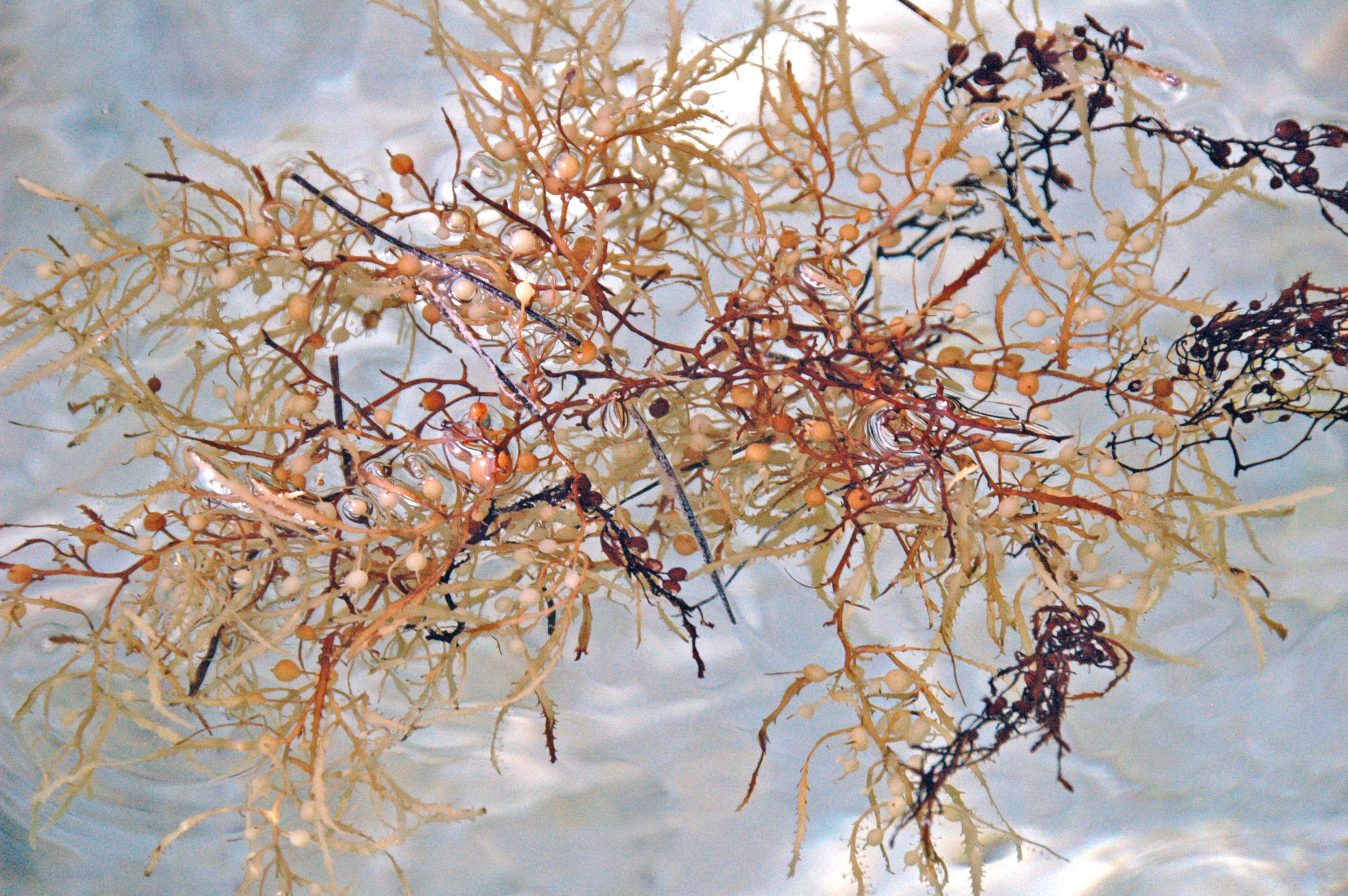
- Small spherical gas-filled bladders spread along its fronds, keeping it permanently afloat at the surface.
- Respiration
- Gas exchange occurs directly across its surface.
- Vision
- None: it has no sensory organs.
- Adaptations
- Unlike most brown algae, it never needs to attach to the seafloor: its entire life takes place adrift on the open sea.
🔗 Web of marine life
Partners
⚡ Its extraordinary abilities
- Reproduces only through fragmentation, with no sexual reproduction ever observed
- Gave its name to an entire sea, the Sargasso Sea, which has no coastline at all
🏆 Records
The world's only sea with no coastline, named after this alga
The Sargasso Sea, in the North Atlantic, is bounded only by ocean currents and takes its name from the vast floating rafts of this alga.
If you cross paths with this animal…
Risk: No direct danger, but its mass decomposition on beaches can release hydrogen sulfide, irritating to the respiratory tract.
Behaviour: Never actively interacts with humans; the problem comes from mass strandings, not the alga itself at sea.
Advice: Avoid lingering near piles of decomposing sargassum on shore.
💡 Did you know?
- The Sargasso Sea is the only sea in the world with no coastline at all, bounded solely by ocean currents.
- Since 2011, a Sargassum belt thousands of kilometers long has stretched across the Atlantic to the Caribbean, visible from space.


