
Marine mammals
Common bottlenose dolphin
Tursiops truncatus
Epipelagic zone · Mesopelagic zone
Intelligent, playful, and capable of recognizing its own reflection, the bottlenose dolphin communicates through a unique 'signature whistle' that functions almost like a name.
🗺️ Geographic range
Found worldwide in temperate and tropical waters, both coastal and offshore — including the Gulf of Mexico, the Mediterranean, Atlantic and Pacific coastlines, and the Indian Ocean.
📊 Population
The global population is estimated at at least 750,000 individuals and appears broadly stable, making it one of the most widespread cetaceans. Some regional populations, notably in the Mediterranean, are classified as Vulnerable due to fishing bycatch, prey depletion from overfishing, and pollution.
Habitat
- Atlantic Ocean · High seas / open water · Epipelagic zone · Permanent
🥚 Reproduction
Gestation lasts around 12 months, producing a single calf that stays dependent on its mother for 3 to 6 years.
Behaviour
- Diet
- It hunts fish, squid, and crustaceans, swallowing prey whole, often head-first to avoid injury from spines.
- Hunting
- It uses echolocation — high-frequency clicks — to locate prey even in murky or dark water.
- Communication
- Each individual develops a unique 'signature whistle' during its first year that functions as its name and remains stable for life.
- Social life
- It lives in fluid 'fission-fusion' groups that split and reform, showing complex social behavior including play, cooperative hunting, and affectionate physical contact.
Physiology
- Anatomy
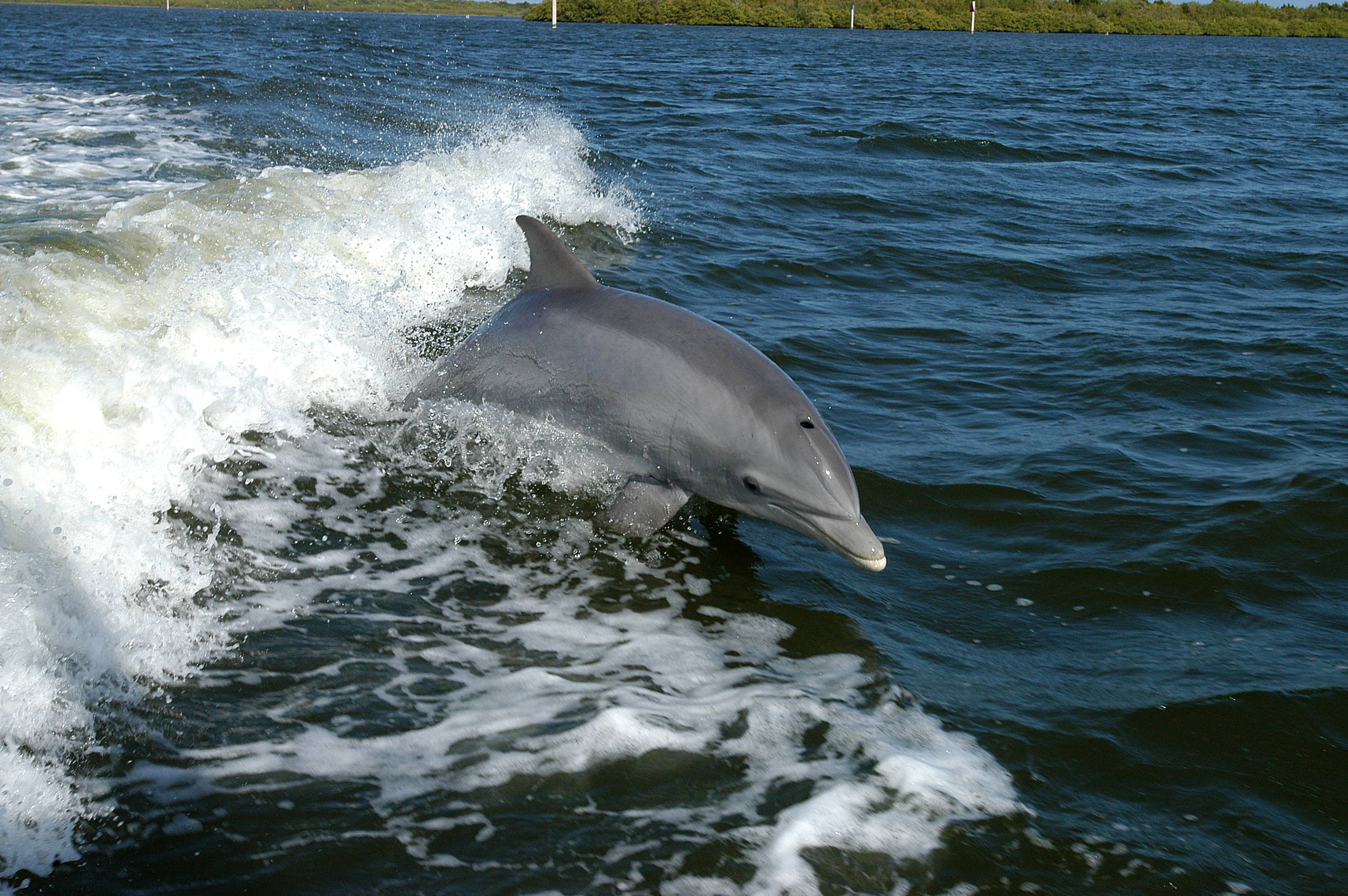
- Sleek grey body, short distinct beak, characteristic curved (falcate) dorsal fin.
- Respiration
- Pulmonary, through a single blowhole; it can hold its breath for several minutes between breaths.
- Vision
- Good eyesight both in and out of water, but it relies mainly on echolocation to 'see' its acoustic environment.
- Adaptations
- Offshore populations can dive hundreds of meters deep, with physiological adaptations that limit nitrogen buildup in the blood.
🔗 Web of marine life
Predators
⚡ Its extraordinary abilities
- A unique 'signature whistle' per individual, used like a name for its entire life
- Echolocation so precise it can detect a fish buried under sand
🏆 Records
Most-studied individual signature call system in a cetacean
The Sarasota Dolphin Whistle Database has tracked the whistles of 293 individual dolphins over spans of up to 43 years.
Source: NOAA Fisheries
If you cross paths with this animal…
Risk: Very low risk to humans in the wild; rare bite incidents have been documented, often linked to human feeding.
Behaviour: Curious and sometimes playful around swimmers and boats, but can become unpredictable if fed or harassed.
Advice: Never feed or touch a wild dolphin; observe from a distance and let the animal approach on its own terms.
💡 Did you know?
- The bottlenose dolphin is one of the few animals known to recognize itself in a mirror.
- Some offshore populations regularly dive past 400 meters, a rare feat for a non-baleen marine mammal.


