
Crustaceans
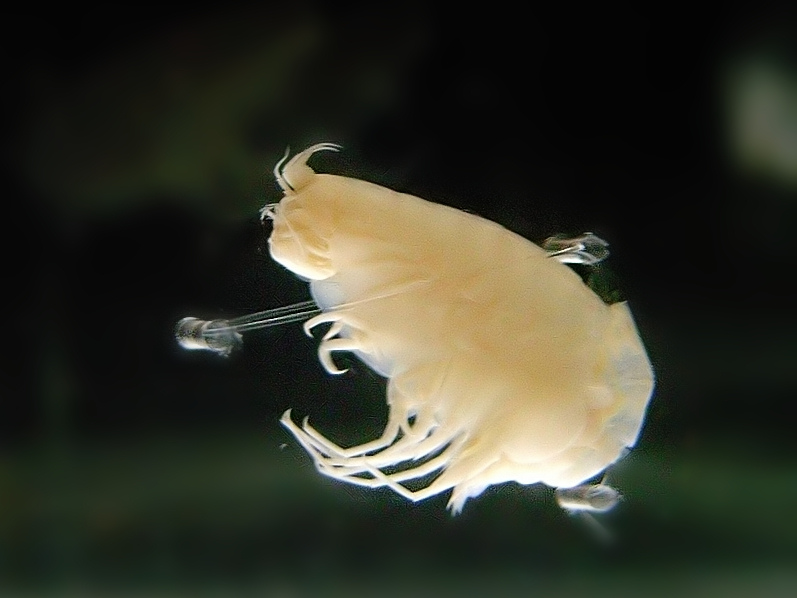
Giant hadal amphipod
Hirondellea gigas
A scavenging crustacean that thrives in the total darkness of the ocean's deepest point, able to digest even sunken wood thanks to a unique enzyme.
🗺️ Geographic range
Hadal trenches of the northwest Pacific, notably the Mariana Trench (Challenger Deep).
📊 Population
No numerical estimate available, but the species is described as one of the most abundant in hadal trenches, sometimes forming genuine swarms around a food source.
Habitat
- Pacific Ocean · Hadal zone · Permanent
Behaviour
- Diet
- Opportunistic scavenger: feeds on any organic debris reaching the floor of the trench, including sunken wood.
- Hunting
- Detects and swarms toward any food source that falls to the bottom, within just a few hours.
- Reproduction
- Poorly documented at this extreme depth.
Physiology
- Anatomy
- Segmented body typical of amphipods, up to 5 cm long, noticeably larger than its coastal-water cousins.
- Adaptations
- Produces a unique cellulase enzyme allowing it to digest wood and other plant polysaccharides, a rare ability among crustaceans.
⚡ Its extraordinary abilities
- Lives down to nearly 10,935 m, one of the deepest-living animals known on Earth
- Produces an enzyme (cellulase) able to digest sunken wood, an exceptional ability for a crustacean
🏆 Records
Among the deepest-living animals on Earth
Found down to nearly 10,935 m in the Mariana Trench (Challenger Deep).
Source: PLOS ONE
If you cross paths with this animal…
Risk: None: inaccessible without a submersible capable of reaching hadal trenches.
Behaviour: Gregarious around any food source.
Advice: Studied only via baited traps lowered from an oceanographic research vessel.
💡 Did you know?
- Has been recovered near the floor of the Mariana Trench, at nearly 10,900 m, one of the deepest points ever explored.
- Can digest wood thanks to an enzyme unique among crustaceans, discovered while studying debris deliberately submerged in the trench.